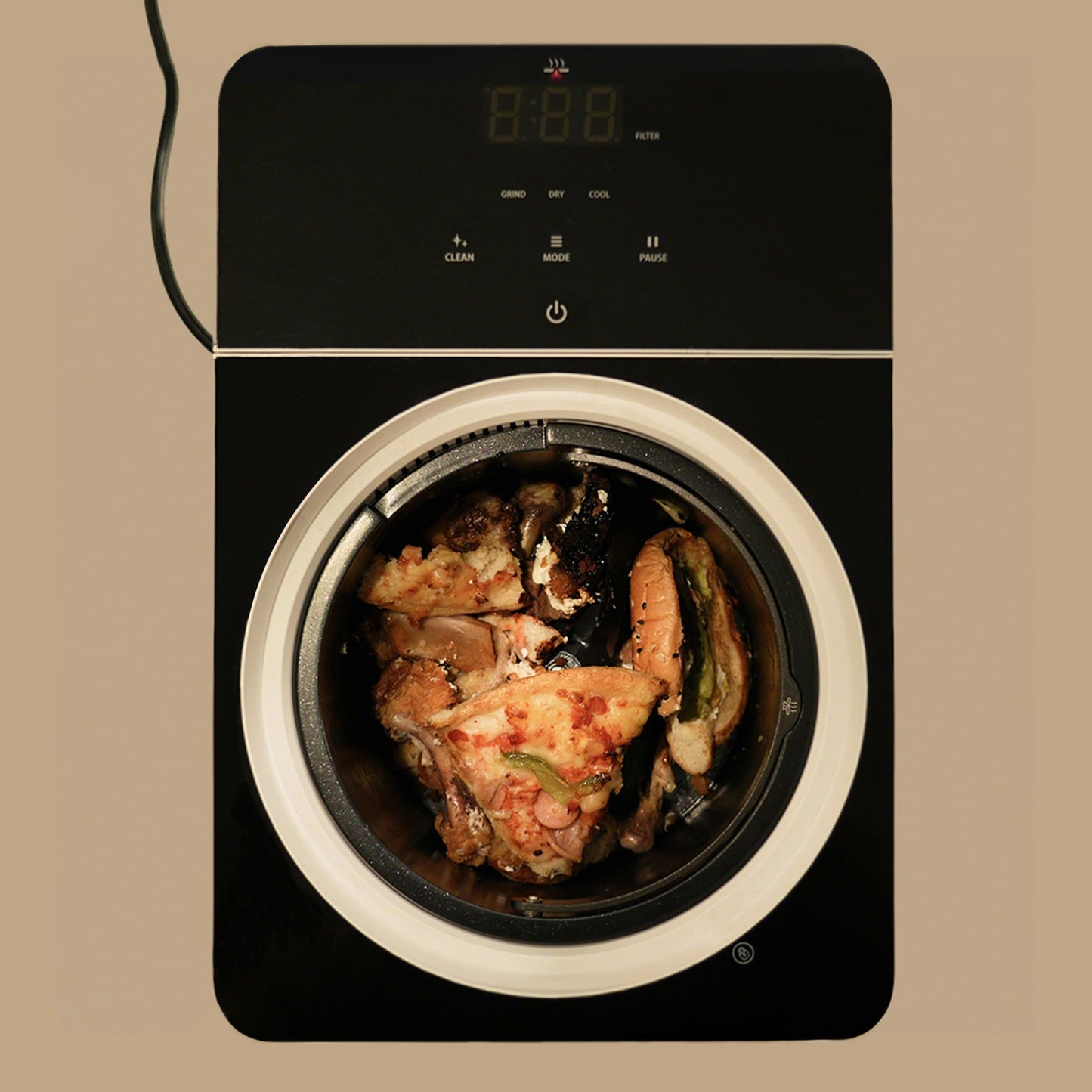
Mill vs Reencle: One Retained-Material Category, Two Different Routines
Mill and Reencle use different processes, but they create the same high-level kitchen commitment: food-derived material remains in a powered floor bin between additions and later removal. Mill dries and grinds additions into accumulating grounds. Reencle asks the owner to maintain an added microbial bed and never harvest below its minimum line.
The useful similarity is the ownership category
A Mill-versus-Reencle comparison can go wrong in two directions. Calling them identical ignores real differences in process and maintenance. Treating them as unrelated lets mechanism language hide the commitment they share.
Both appliances occupy floor space, remain powered during normal use, accept new scraps while food-derived material is already inside, and postpone full or partial removal. That makes both bins that retain processed or partly processed material between additions.
Their internal routines are not the same. Mill says scheduled cycles dry and grind new inputs. Reencle says an owner-added starter supports biological activity under managed heat, mixing, airflow, and moisture. A buyer should understand both the shared commitment and the different work inside it.
For the broader category map, start with the two electric-composter ownership systems.
Mill's routine: process additions and accumulate grounds
Mill describes its output as Food Grounds: food with water and bulk removed, not the result of a composting device. Owners can add scraps while the appliance remains in service. Scheduled Dry & Grind cycles process those additions, while previously processed grounds stay in the bucket.
The practical emptying trigger is the fill line. Mill's instructions tell the owner to remove the bucket and pour out the dry, cool grounds. Its support material notes that some caked residue may remain and loosen during later use, but it does not assign that residue the role of a required starter bed.
Mill also says low-speed fans run throughout the day to maintain negative pressure. That does not mean the heater and grinder run continuously. It means the appliance remains an active air-managed vessel while stored grounds and new inputs share the bucket.
Sources: Mill cycle description, Dry & Grind scheduling guidance, emptying instructions, and sound and fan guidance, retrieved August 26, 2026. These are manufacturer-published descriptions, not independent performance tests.
Reencle's routine: preserve an active bed
Reencle's setup requires the owner to add a packaged starter and water, wait for activation, and keep the appliance powered during normal operation. The microbes are not embedded machine hardware. They are an owner-added input placed in a chamber whose hardware manages the operating environment.
The clearest ownership rule appears in Reencle's harvest instructions. When the material reaches MAX, the owner scoops it down only to MIN, not below it. Undecomposed pieces are sieved out and returned to the chamber. Reencle says dropping below MIN can interfere with stirring, decomposition, and odor control.
Moisture condition is also part of the routine. Reencle tells owners to inspect the bed and adjust food, water, or recovery steps when it becomes too wet or too dry. The existence of those instructions does not prove that every owner encounters a problem. It does document a biological state that the owner is expected to preserve.
Sources: Reencle Gravity setup, moisture-care guidance, and MAX-to-MIN harvest instructions, retrieved August 26, 2026. They establish Reencle's prescribed routine, not independently measured decomposition performance.
Side-by-side: what the owner actually does
| Buyer question | Mill | Reencle |
|---|---|---|
| What is added at setup? | The appliance and bucket; no functional starter bed is prescribed | Packaged starter plus water, added by the owner |
| What happens to new scraps? | Mill says scheduled cycles dry and grind them | Reencle says they enter an active microbial bed |
| What remains between additions? | Accumulated processed grounds | A moist active bed plus material in process |
| What is the removal trigger? | Grounds reach the fill line | Material reaches MAX |
| How far does the owner empty? | Pour out the bucket; incidental caking may remain | Harvest only to MIN; do not remove the required bed |
| What is managed between removals? | Schedule, airflow path, fill level, and carbon | Bed level, moisture, input balance, airflow, cleanliness, and carbon |
| Can the main vessel return to empty? | Yes, as an emptying routine | Not during ordinary harvesting; the bed must remain at or above MIN |
The table describes published ownership instructions. It does not establish which system smells less, consumes less carbon, or performs better under the same food load.
Why “same routine” needs one important correction
At a distance, both products look like a simple habit: keep adding scraps and empty less often. Close up, the emptying rules diverge.
Mill's retained inventory is accumulated dry ground material. Its bucket can be poured out. Reencle intentionally preserves a working bed and requires the owner to stop at a minimum line. The bed's moisture and condition remain operating variables.
The practical difference is what you leave inside after emptying:
Mill and Reencle belong to the same retained-material ownership category, while using different process, maintenance, and removal rules.
That distinction is more useful than accepting either marketing label as the complete product definition.
What the output language does not settle
Mill explicitly says its Food Grounds are still food with water and bulk removed. Reencle calls harvested material compost and publishes different destination instructions. Its support page says surface mulching may be immediate, while planting or seed contact requires mixing one part harvested material with four parts soil and curing for three to four weeks.
Those are Reencle's instructions, not an independent stability test. More importantly, a fast change in appearance is not the same measurement as particle residence time, harvest frequency, biological stability, or destination readiness.
Source: Reencle post-harvest use guidance, retrieved August 26, 2026.
Carbon and odor claims need a same-basis test
Both systems move air from a vessel containing retained food-derived material through an odor management path. That makes filter upkeep part of the ownership system. It does not let us infer an exact carbon-consumption rate from vessel size, price, or a stated calendar interval.
Filter-life comparisons need a common test method that records food inputs, humidity, airflow, operating time, installed carbon, and the odor level that counts as failure. Replacement intervals alone cannot show which machine controls odor better.
See how airflow, odor source, and activated carbon interact for the measurement framework.
Who is each system for?
Choose Mill if you want scheduled drying and grinding in a floor bin and prefer to accumulate dry grounds before pouring out the bucket. The tradeoff is a powered retained-material vessel, a fill line to watch, and an airflow and filter system to maintain.
Choose Reencle if you specifically want its added-starter routine and are comfortable preserving a moist active bed, monitoring its condition, and harvesting only from MAX down to MIN. The tradeoff is that the working material intentionally remains in the machine.
Choose a finish-and-empty batch machine if you prefer a defined load, a defined cycle, and the ability to return the vessel to empty. See Natridy vs Mill and Natridy vs Reencle for those direct ownership comparisons.
FAQ
Are Mill and Reencle the same type of machine? They belong to the same high-level retained-material ownership category: both remain powered with food-derived material inside between additions and later removal. Their processes differ. Mill dries and grinds; Reencle asks the owner to maintain an added microbial bed.
Does Reencle have microbes built into its hardware? No. Reencle's setup instructions require the owner to add a starter packet and water. The hardware then manages conditions around that input. The starter is part of the operating system, but it is not a capability embedded in a motor, heater, fan, or circuit board.
Can you empty both machines completely? Mill's instructions allow the bucket to be poured out, although incidental caking may remain. Reencle's ordinary harvest routine explicitly says not to go below the MIN line because the active bed must remain.
Does either company prove that its odor control is better? The published replacement intervals do not establish an odor-control winner. A useful comparison needs matched food loads and conditions, measured airflow and carbon mass, and the same definition of odor breakthrough.