Batch vs Retained-Bin Electric Composters
Food-waste appliances create two broad ownership routines: process and empty a selected batch, or keep processed or biologically active material in a powered vessel between additions and later removal. The mechanism still matters, but the first household question is what remains inside and when the owner empties or harvests it.
Start with the ownership system, not the marketing category
Most comparisons begin with decibels, bucket size, or an argument about the word compost. Those details matter after a more practical decision:
Do you want to finish and empty one batch, or keep material in a powered vessel between meals?
That question separates the category into two ownership systems more clearly than brand labels do. Mill's retained dry grounds and Reencle's retained microbial bed are not the same mechanism, but both require the owner to manage material that remains in a powered vessel.
Four measurements that should not be collapsed
- Working batch: the new load permitted for one batch.
- Processing time: the duration of a named cycle or scheduled event.
- Retained inventory: material that remains in the vessel after that event.
- Emptying cadence: the fill-line, harvest, or batch-completion trigger for removal.
A bucket volume, a daily input allowance, cumulative throughput, and weeks to a fill line do not measure the same thing.
System one: finish-and-empty batch machines
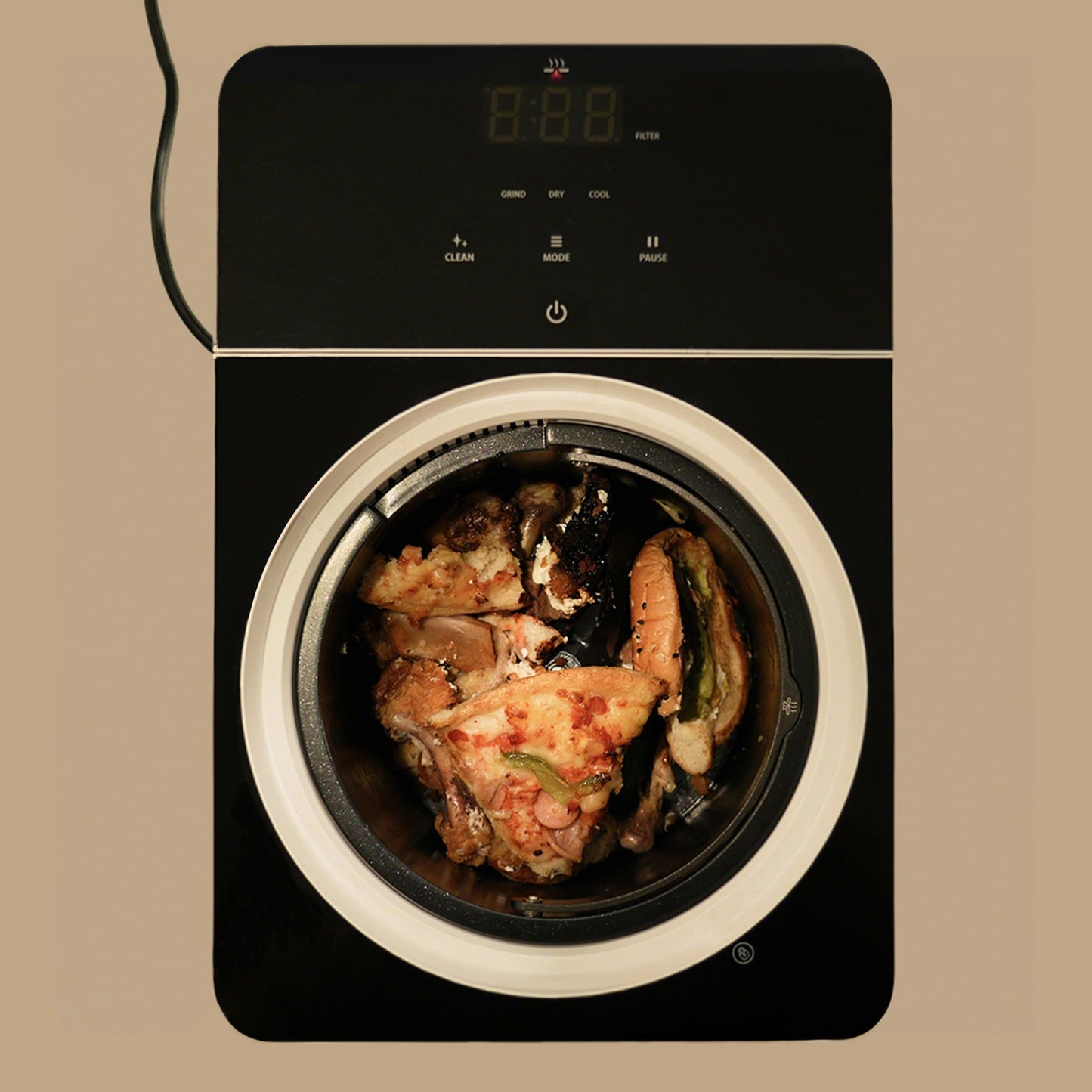
Natridy, Lomi, and FoodCycler publish batch routines. The owner loads a supported amount, runs a named cycle, and can remove the result after completion. Compare each named model's working load, mode, energy, cleaning, and output instructions.
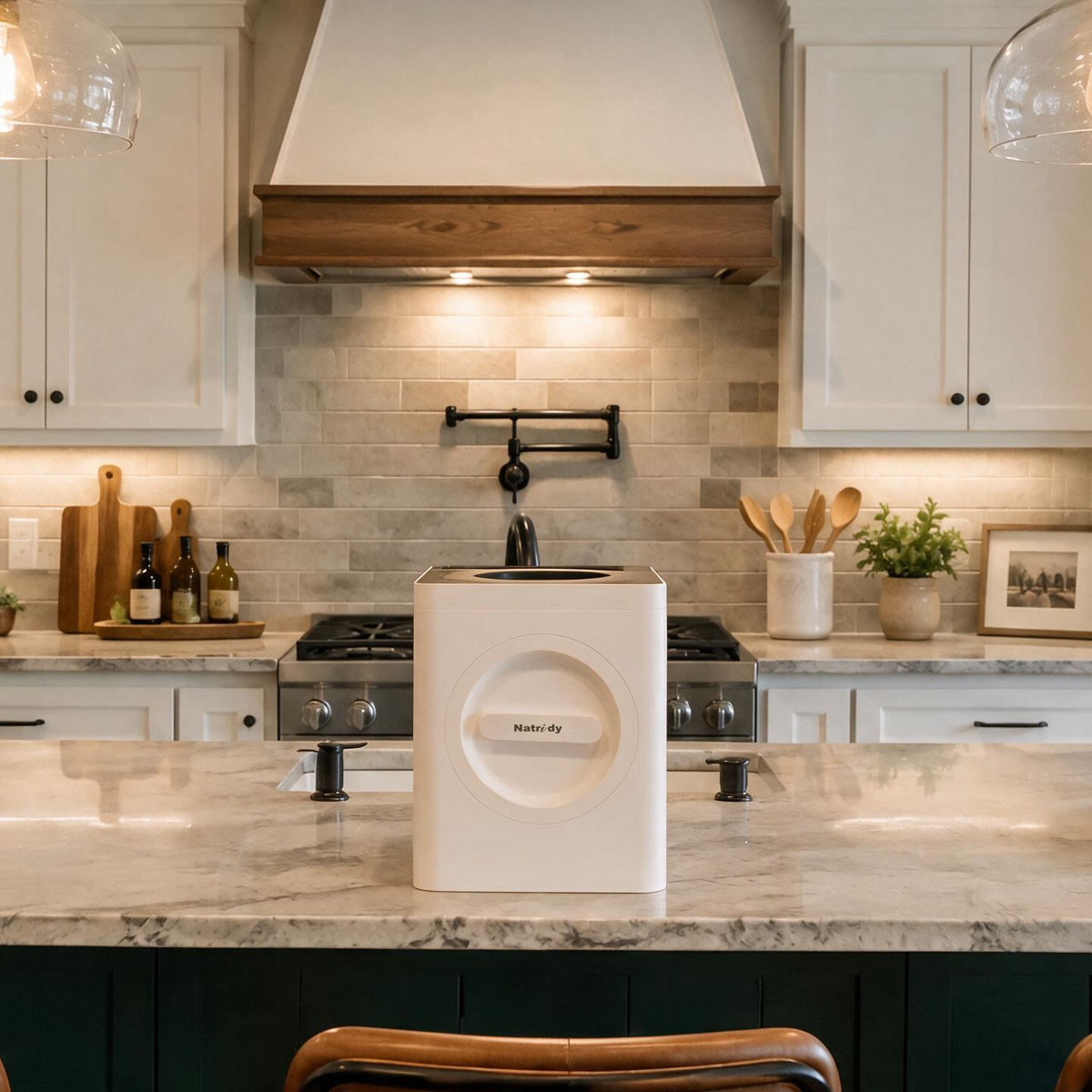
On the Natridy CYF01, a comfortable working batch is 68 oz (2 L) inside a 100 oz (3 L) drum. Energy use is ~1 kWh per 4-hour cycle. The machine runs when you choose to run it.
The other batch brands add their own controls, programs, and consumables. The ownership pattern is still recognizable: one load in, one processed load out, then an empty bucket is available again.
System two: retained-bin routines
Mill and Reencle use vessels that remain part of the kitchen between meals. The owner keeps adding material, and the appliance stays powered to manage what remains inside. Emptying or harvesting uses a fill-line or harvest trigger rather than the completion of every processing event.
This is the common design reality. Mill describes drying and grinding directly. Reencle asks the owner to add a starter packet, while its machine supplies heat, mixing, and airflow around retained material. The starter may affect what happens biologically, but it does not change the household's always-on floor-bin commitment.
Mill: accumulate dry grounds
Mill says scheduled Dry & Grind events process additions while Food Grounds accumulate until the fill line. Its cycle duration and emptying interval are different clocks. A claim such as “up to four weeks” describes a variable fill interval, not one unchanged raw load and not a guaranteed monthly emptying schedule.
The precise interval varies, but the design intent is clear: processed grounds remain in the floor bin for weeks while new scraps are added and additional cycles run.
Sources: Mill Dry & Grind guidance and Mill emptying instructions, retrieved September 3, 2026.
Reencle: maintain an active starter bed
Reencle ships with a microbial starter that the owner adds during setup. The microbes are not a capability embedded in a circuit board. They are a living input placed into a chamber where the hardware supplies heat, mixing, and airflow.
The active bed stays in the machine. Reencle's operating instructions say to remove roughly half when material reaches the maximum line and to keep material at or above the minimum line. The unit is not emptied back to a clean vessel after each day's scraps.
That is why Reencle belongs in the same continuous-retention ownership class as Mill. An owner-added starter is an input, not embedded machine hardware. Both products ask the owner to keep food-derived material in an always-on floor appliance between additions and removal.
Source: Reencle harvest instructions, retrieved September 3, 2026.
A first-principles comparison
| Buyer question | Finish-and-empty batch | Continuous-retention bin |
|---|---|---|
| What happens after today's scraps? | Run one batch, then empty it | Add them to material already retained in the vessel |
| Does the vessel return to empty? | It can after every cycle | Normally no; grounds or an active bed remain inside |
| When does it use power? | During a chosen batch | Stays powered to manage retained material |
| Where does it live? | Countertop class | Floor-bin class |
| What controls odor? | Sealed batch plus activated-carbon airflow | Continuous airflow and odor control around retained material |
| What does the owner manage? | Batch size, exclusions, cleaning, carbon | Fill level plus ongoing system condition and odor control |
| Examples | Natridy, Lomi, FoodCycler | Mill, Reencle |
The table describes the buyer-visible machine and ownership system. It does not claim that every reaction inside each vessel is identical.
Compare all three clocks
| Clock | Question |
|---|---|
| Processing | What named event starts and stops? |
| Vessel retention | What remains after that event, and what triggers removal? |
| Post-removal | What collection, composting, curing, storage, or disposal step remains? |
A short cycle does not establish an empty vessel or garden-ready output. EPA says residential grinder-dehydrator output is not biologically stable compost and needs an appropriate next step.
Source: US EPA — Approaches to Composting, retrieved September 3, 2026.
Carbon capacity is physics, not a replacement-price claim
Activated carbon has finite adsorption capacity. Odor load does not disappear because a product page assigns a long replacement interval or a low refill price. A serious filter comparison needs at least five inputs: carbon mass, airflow, food load, time under load, and the threshold used to declare odor breakthrough.
That is especially important for a retained-bin routine, where the source and airflow conditions differ from a batch appliance that can be emptied after a cycle. Those differences do not produce an exact filter-consumption number by themselves. Treat each published replacement interval as maker maintenance guidance and use the electric-composter odor guide before interpreting odor as carbon depletion.
Who should choose each system?
Consider a retained-bin appliance if you want to keep adding scraps without planning individual batches, have floor space, and will follow the product's fill-line, cleaning, and destination instructions. Mill retains dried grounds; Reencle retains an owner-maintained microbial bed.
Consider a finish-and-empty batch machine if you prefer a defined start and finish and want the vessel available to return to empty between uses. Natridy is a countertop example with a 68 oz (2 L) working batch inside a 100 oz (3 L) drum, 39 dB measured noise, and about 1 kWh per 4-hour reference cycle.
Choose none of them if a covered crock, freezer container, municipal green bin, or outdoor pile already solves the problem cleanly.
FAQ
Are Mill and Reencle the same machine? They are not identical products, but they belong to the same continuous-retention appliance class. Both remain powered with food-derived material inside between additions and removal. Reencle asks the owner to add a starter packet; that input does not turn its heat, mixing, airflow, vessel, and odor-control hardware into a separate ownership category.
Does Reencle have microbes built into the machine? No. The owner adds a microbial starter during setup. The hardware manages the environment around that starter through heat, airflow, and mixing. Whether removed material is ready for a destination must be evaluated separately from how quickly scraps change inside the chamber.
Does Mill keep scraps for four weeks? Mill advertises up to four weeks to fill, but that does not mean raw scraps remain untreated for four weeks. Scheduled cycles dry and grind new inputs. The resulting grounds accumulate until the owner empties the vessel, often weeks later.
Which design uses less electricity? It depends on household frequency. Natridy uses ~1 kWh per 4-hour cycle and runs only when a batch is started. Mill publishes roughly 0.7 kWh per day averaged across weeks. Reencle publishes approximately 1.13–1.25 kWh per day. Compare your expected Natridy cycles per week with the continuous system's daily consumption rather than comparing one cycle with one day.
Do Mill's or Reencle's published filter intervals prove low carbon consumption? No. An interval is not a capacity test. A defensible comparison needs carbon mass, airflow, food load, operating time, and an odor-breakthrough threshold measured on the same basis.