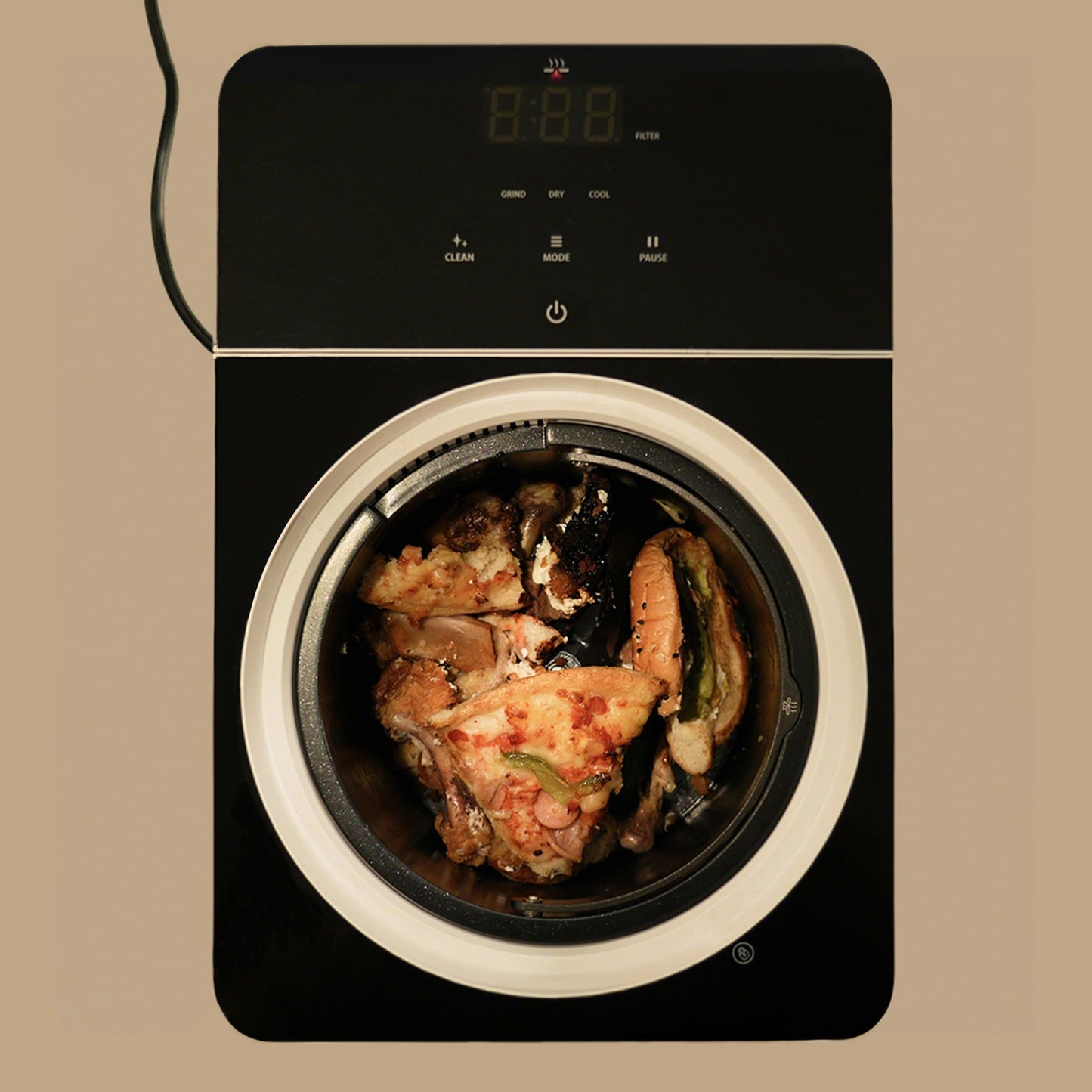
Electric Composter Odor: A Diagnostic Guide
Use the same three-step sequence whenever odor appears:
- Source: Check wet or incompletely processed material, excess liquid, residue, and whether the cycle finished as expected.
- Air path: Follow the supplied guide to check accessible vents, screens, seals, filter seating, and the intended exhaust path. Do not open electrical areas or improvise service.
- Carbon: If the material and air path are in order but odor still passes through the exhaust during operation, evaluate the activated carbon and replace it according to the model instructions.
Carbon is the last step in the path. A fresh refill cannot dry a wet load or correct air that bypasses the filter. Conversely, cleaning the drum cannot restore adsorption capacity after odor begins passing through correctly installed carbon.
Start with the chain, not the filter calendar
Warm food material can release water vapor and volatile compounds. A fan moves that air through an intended path. Activated carbon adsorbs some compounds on its internal surface. The treated exhaust then enters the room.
That creates a practical diagnostic chain:
- Source: What inside the drum or retained vessel is producing the odor?
- Air path: Is air following the intended route through seals, vents, dust screens, and the filter housing?
- Carbon: Does the installed carbon still have useful working capacity?
The non-obvious point is that carbon is downstream. It can treat air that reaches it, but it cannot make an overly wet or incompletely processed source disappear.
Three odor patterns to distinguish
| What you notice | Likely part of the chain to inspect first | First check | What not to assume |
|---|---|---|---|
| Material smells when you open the drum | Source | Wet load, excess liquid, incomplete drying, residue | Do not assume a new filter will dry the material |
| Odor appears mainly at the exhaust during a cycle | Transport or capture | Filter seating, intended airflow path, carbon condition | Do not assume the drum is the only cause |
| Odor persists around a retained-material bin between processing events | Source plus ongoing airflow/capture load | Retained material condition, moisture, cleanliness, vents, carbon | Do not infer performance from a long stated replacement interval |
| Room odor starts after previously clean cycles | Capture, after source/path checks | Whether odor now passes through correctly seated carbon | Do not assume calendar age alone proves saturation |
This is a reasoned diagnostic model, not a universal appliance test. Each manufacturer's care instructions still control safe cleaning and filter access.
Correct a source problem before asking carbon to hide it
Moisture matters because wet organic material can create a different environment from a properly processed, dry batch. Cornell's compost guidance explains the general principle: excess moisture can fill pore space, restrict oxygen movement, and contribute to foul-smelling anaerobic conditions. A countertop appliance is not a compost pile, but the source lesson still applies—water and oxygen conditions affect odor generation.
For a finish-and-empty batch machine, inspect excess liquid, overloading, large wet pieces, residue, and whether the material actually reached the intended dry result. For a retained-material system, the owner may also need to manage moisture and the condition of material that remains between additions.
Sources: Cornell monitoring compost moisture and Cornell factors leading to anaerobic conditions, retrieved August 26,
- These sources explain general organic-material behavior, not measured performance for a specific kitchen appliance.
Air has to pass through the intended treatment path
A carbon refill on a shelf does nothing. The machine has to move source air through installed carbon before exhaust reaches the room. A gap, incorrectly seated filter, obstructed screen, dirty vent, or unintended leak can bypass or restrict that path.
Natridy uses a dual-channel air path with 2x venting through activated carbon. That describes the architecture; it does not mean twice the airflow, twice the adsorption, or zero odor. Its replacement carbon is supplied as a 1.32 lb (600 g) refill.
Mill likewise says its drying air passes through an odor-management system containing a carbon filter before exhaust leaves the rear sides. Reencle says air circulates through activated carbon before leaving a rear vent. These are manufacturer-published air-path descriptions, not comparable odor-removal tests.
Sources: Mill cycle description and Reencle Prime carbon-filter help, retrieved August 26, 2026.
Activated carbon has finite working capacity
Activated carbon does not operate by knowing how many months have passed. Compounds adsorb to available surface until the bed approaches a useful limit and a meaningful concentration begins to appear downstream. Engineers call that outlet event breakthrough.
The US EPA's industrial carbon-adsorber guidance distinguishes maximum saturation from earlier breakthrough and identifies variables such as inlet concentration, gas flow, moisture, temperature, operating time, outlet concentration, and carbon activity. A kitchen odor mixture is not an industrial single-VOC stream, so those variables do not create an appliance rating. They do show why a calendar interval alone is not a capacity test.
A serious comparison would disclose carbon mass, food inputs, humidity, airflow, operating time, and the threshold used to declare odor breakthrough. Without that common method, “months per filter” remains a manufacturer maintenance claim rather than evidence of cross-brand superiority.
Source: US EPA activated-carbon adsorber monitoring guidance, retrieved August 26, 2026. The EPA page concerns industrial air-emissions control and is used here only for adsorption and breakthrough concepts.
Competitor troubleshooting qualifies the headline promise
Mill's product marketing uses “never smell” and “blocks 99.9% of odors.” Its support material nevertheless tells owners to investigate moisture, particular food inputs, a dirty dust filter, filter installation, and eventual carbon replacement when grounds smell.
Reencle markets a “Zero Odor” system and publishes a 9–12 month replacement recommendation. Its controls page says the higher-fan Purify mode can reduce odor but does not fix the root cause. Its support guidance points owners toward moisture, input balance, and cleanliness.
That contrast does not prove either machine performs poorly. It demonstrates the diagnostic chain: a headline promise describes an intended outcome, while the operating instructions acknowledge source, transport, and capture failure modes.
Sources: Mill product page, Mill odor troubleshooting, Reencle Prime controls, and Reencle odor guidance, retrieved August 26, 2026.
Apply the three-stage diagnostic
- Inspect the source. Record whether odor appears before a cycle, only during exhaust, after the cycle, or continuously around a retained-material vessel. Look for excess liquid, wet output, stuck residue, or a load that did not finish as expected. Clean only the surfaces named in the manual; do not wet electrical parts or improvise filter access.
- Inspect the air path. Confirm the owner-accessible vents and screens are clear and carbon is correctly seated, following the supplied guide.
- Evaluate carbon last. If the source is corrected, the path is intact, and odor still passes through during operation, replace the carbon according to the model instructions.
For Natridy-specific replacement signs, use the carbon filter guide. Replacing carbon by symptom after the upstream checks is more informative than treating a calendar as a performance measurement. For the variables behind capacity, breakthrough, and honest comparisons, continue with the activated-carbon capacity guide.
What a fair odor test would show
A credible small-appliance comparison would use the same input recipe and mass, starting moisture, room conditions, operating duration, airflow measurement, carbon mass, and odor-breakthrough endpoint. It would also separate human odor-panel observations from instrument measurements.
A larger carbon refill, two air channels, a higher fan speed, or a longer replacement interval does not by itself establish better odor control. Compare odor results under matched food loads and operating conditions.
FAQ
Does a smell mean the carbon is full?
Not by itself. First check the material that creates the odor, then the accessible air path and filter seating. Carbon condition becomes the stronger explanation only after those upstream checks are sound and odor still passes through the exhaust.
When should I replace activated carbon?
Replace carbon at the interval specified for your model, or investigate earlier if exhaust odor persists after checking the food residue, accessible air path, and filter seating. Odor inside an opened drum alone does not establish that the carbon needs replacing.
Source: US EPA activated-carbon adsorber monitoring guidance, retrieved September 3, 2026. The EPA source explains adsorption and breakthrough concepts; it is not a performance test of a kitchen appliance.