Natridy vs Mill: Batch or Retained Bin?
Natridy processes a selected countertop batch that can be removed after the cycle. Mill processes additions on a schedule while Food Grounds accumulate in a floor bin until the fill line. Compare the working load, retained inventory, space, energy denominator, emptying trigger, and final destination instead of treating one bucket as a larger version of the other.
The decision is not simply small versus large
A specification table can make Mill look like a larger version of a countertop electric composter. That misses the physical difference a household has to live with.
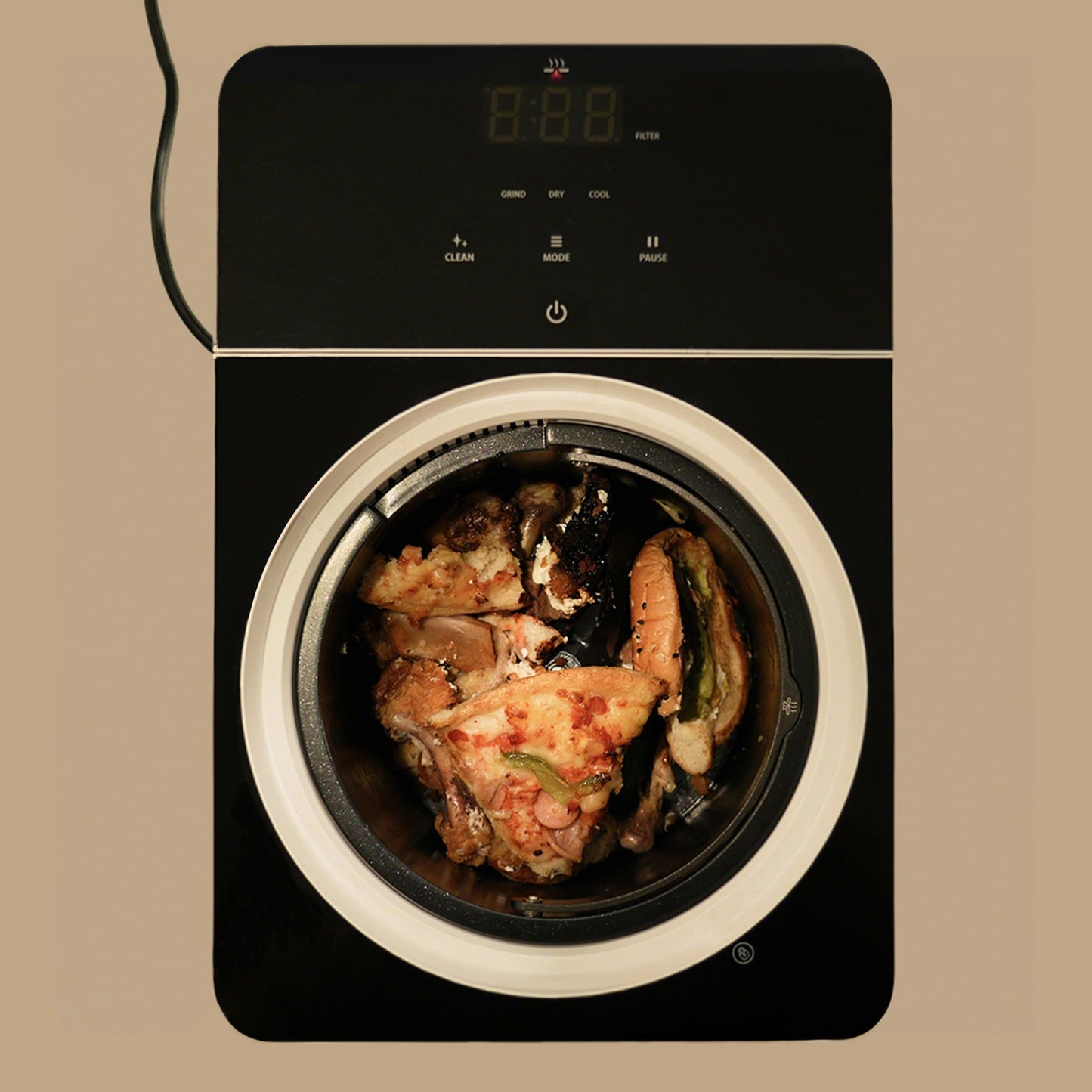
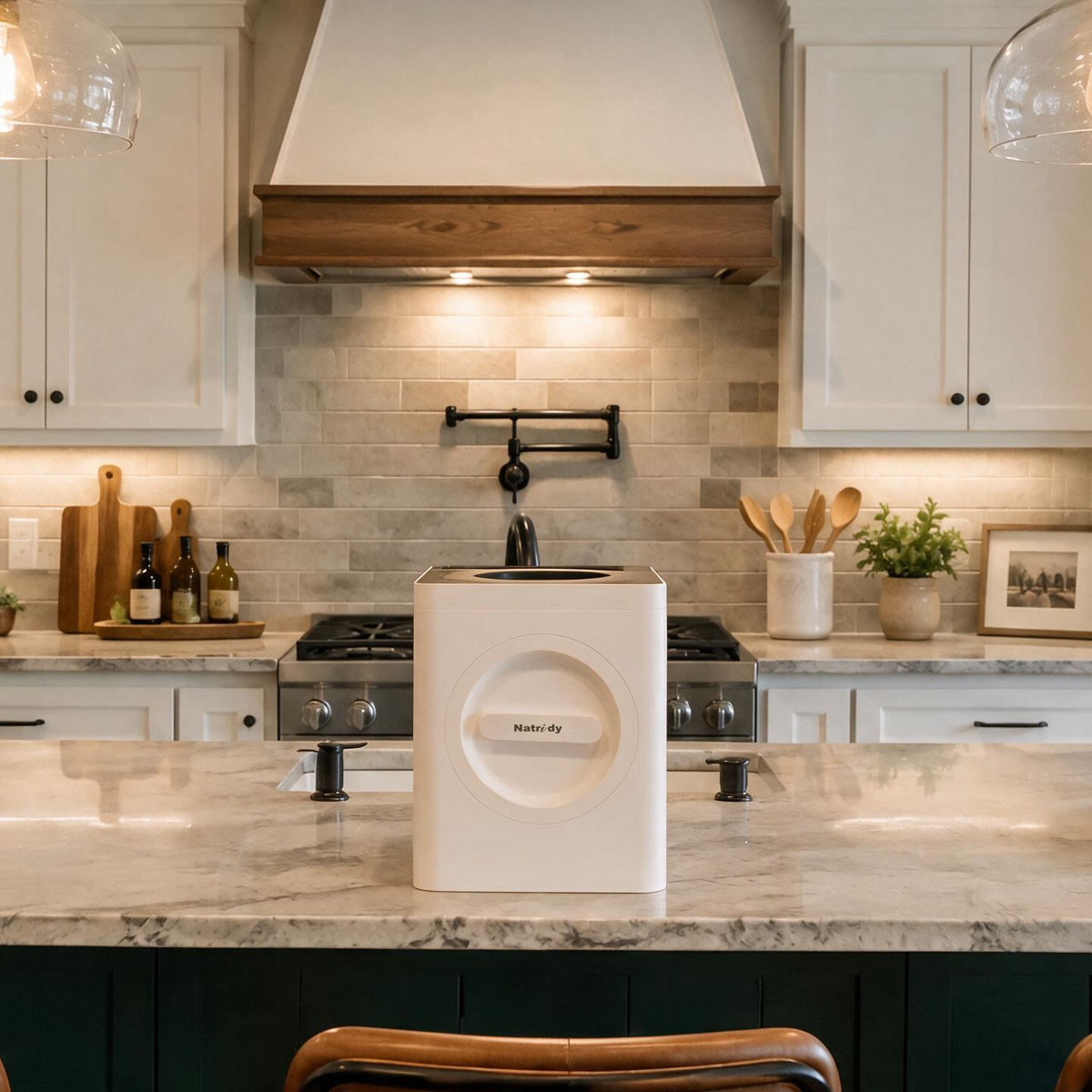
Natridy has a 100 oz (3 L) drum with a 68 oz (2 L) working batch. The owner loads a batch, starts the machine, and can empty the dry, ground food-scrap material after the cycle. The drum can return to empty before another load.
Mill uses a 6.5 L bucket inside a floor-standing appliance. Mill says scheduled cycles dry and grind new additions into what it calls Food Grounds. Those processed grounds remain in the bucket while later scraps are added, until the owner empties at the fill line.
That makes this a comparison between finish and empty and process and accumulate. Neither routine is universally better, but they are not interchangeable.
The capacities answer different questions
The most important non-obvious fact in this comparison is that 2 L and 6.5 L are not two versions of the same measurement.
- Natridy's 68 oz (2 L) figure is a recommended working batch inside its 100 oz (3 L) drum.
- Mill's 6.5 L figure is the bucket that holds previously processed grounds plus later additions.
- Mill separately publishes an input specification of up to 10 lb of new wet scraps per cycle.
The Mill bucket therefore describes an accumulating system, while the Natridy figure describes one working load. Treating the two numbers as daily throughput would be a false comparison.
Sources: Mill Essential technical specifications and Mill Plus technical specifications, retrieved August 26, 2026.
What “up to four weeks” actually means
Mill's current marketing uses an up-to-four-week capacity frame. Its support pages use other intervals: one says most households take “a couple weeks” to reach the fill line, while a pickups article gives 4–6 weeks as an average and says the result depends on how many scraps the household generates.
Those statements are not a single guaranteed emptying interval. The reliable operating instruction is simpler: keep adding material while scheduled cycles process it, then empty when the grounds reach the fill line.
This also means it is inaccurate to say that untreated raw scraps simply sit unchanged for four weeks. Mill says new additions are dried and ground. The first-principles ownership point is that food-derived material remains in the appliance between additions and scheduled processing, often for weeks.
Sources: Mill configuration page, Mill emptying instructions, and Mill pickups frequency, retrieved August 26, 2026.
Natridy vs Mill ownership table
| Buyer question | Natridy | Mill Essential / Plus |
|---|---|---|
| Appliance class | Countertop batch appliance | Floor-standing retained-output appliance |
| What remains between uses? | Nothing if the owner empties the finished batch | Previously processed Food Grounds remain until the fill line |
| Capacity meaning | 68 oz (2 L) working batch in a 100 oz (3 L) drum | 6.5 L accumulating bucket; Mill also publishes up to 10 lb of new wet input per cycle |
| Energy use | ~1 kWh per 4-hour cycle | Mill reports about 0.7 kWh per day from Mill Plus usage data; this is not a separate Essential estimate |
| Footprint | 9.84 x 14.3 x 11.8 in | Mill publishes about 23 x 17 x 14 in for Essential and 27 x 17 x 14 in for Plus |
| Output description | Dry, ground food-scrap material | Mill calls it Food Grounds and says it is still food, not compost |
| Emptying trigger | The chosen batch is complete | Grounds reach the fill line |
Mill supplies the specifications above. Capacity, energy use, and emptying frequency describe different parts of ownership, so compare them against your household’s scrap volume and available space.
Compare electricity over the same time window
Natridy publishes about 1 kWh for a 4-hour reference cycle. Two cycles per week would use about 8 kWh over 28 days; four would use about 16 kWh. These are arithmetic scenarios, not household promises.
Mill publishes about 0.7 kWh per day based on Mill Plus usage over multiple weeks. At that rate, 28 days would use about 19.6 kWh. Actual use varies with cycle frequency, scrap quantity, and moisture; the source does not give a separate Essential estimate.
The fair comparison uses the same period and records the food handled. Comparing one Natridy cycle with one Mill day would answer the wrong question, and the unlike denominators do not establish an efficiency winner.
Source: Mill energy-use estimate, retrieved September 3, 2026.
Floor space changes the experience
Natridy's smaller footprint is designed for a countertop. Mill's height and floor-bin format allow an accumulating bucket, but they also create a permanent floor-space decision. Measure the actual location, lid clearance, ventilation clearance, and walking path before deciding that more capacity automatically fits better.
The inverse is also true. A household that dislikes planning batches may prefer a larger bin that accepts additions while it runs. Someone who wants the vessel empty and visually finished after each load may prefer a smaller working batch.
Both outputs still need a destination
Mill says its Food Grounds are still food with much of the water and bulk removed. Natridy calls its result dry, ground food-scrap material. Neither description means finished compost.
Before buying either appliance, decide where the output will go: an accepted municipal organics program, an outdoor compost system, another permitted collection route, or storage until handoff. Drying and grinding can change handling; they do not eliminate the destination decision. For the broader category distinction, read Electric Composters Don't Make Compost.
Who should choose each routine?
Consider Natridy if countertop placement, a defined batch, and the ability to return the drum to empty fit the household. Consider Mill if floor space, scheduled processing, and a retained-ground fill-line routine fit better.
Choose neither if a freezer container, covered caddy, municipal green bin, or outdoor system already solves the storage and destination problem cleanly. The best machine is not automatically better than a simpler routine that already works.
FAQ
Does Mill keep raw food waste for four weeks? Not in the crude sense that scraps remain unchanged. Mill says scheduled cycles dry and grind new inputs into Food Grounds. Those processed grounds accumulate in the bucket until the fill line. “Up to four weeks” is Mill's capacity framing, while its support pages say actual filling time varies by household.
Is Mill's 6.5 L bucket directly comparable with Natridy's 68 oz working batch? No. Natridy's 68 oz (2 L) figure describes one recommended working batch. Mill's 6.5 L figure describes a bucket that accumulates previously processed grounds plus later additions. They answer different questions, so neither number by itself proves greater daily throughput or a better fit.
Which system uses less electricity? It depends on cycle frequency and how much food each machine processes. Natridy publishes ~1 kWh per 4-hour cycle. Mill reports about 0.7 kWh per day from Plus usage data. Compare the same period and food quantity; use Essential-specific energy data when considering that model.
Should an apartment household choose Natridy or Mill? Measure the available space and choose the routine. Natridy fits the countertop class and can return to an empty drum after a batch. Mill occupies floor space and retains processed grounds until the fill line. A municipal caddy or freezer container may be better if neither footprint fits.