Why Food Scraps Are Heavy: Water, Weight, and Kitchen Storage
This page covers one narrow question. For moisture, weight and local destinations, see the apartment composting guide.
Food scraps are often heavy because the discarded food still contains substantial, highly variable water. Drying removes part of that water, so the final mass depends strongly on the input recipe and endpoint moisture. A reduction percentage without starting mass, food mix, and final measurement conditions is incomplete.
Wet mass is not the same as persistent solids
A kitchen scale measures water together with carbohydrates, protein, fat, fiber, minerals, bones, shells, and packaging mistakes. When water evaporates, measured mass falls even though the remaining food-derived solids have not vanished.
USDA FoodData Central records water as a measured proximate component and shows that moisture varies by food. USDA separately notes that meat and poultry naturally contain water. A mixed household scrap bucket has no universal moisture percentage because its recipe changes every day.
Sources: USDA FoodData Central, Foundation Foods documentation, and USDA Water in Meat & Poultry, retrieved August 28, 2026.
The same bucket volume can carry different mass
Compare two 2 L working loads:
- loosely packed peels and leafy trimmings;
- dense cooked rice, sauce, meat scraps, and liquid.
They occupy similar volume but can differ in mass, free liquid, grinding resistance, drying demand, and odor load. That is why liters, pounds, daily throughput, and weeks-to-fill should never be used as interchangeable capacity units.
The capacity guide separates vessel volume, new input, retained inventory, and fill time.
Water changes apartment storage before processing
Free liquid can leak, spread residue, and increase the wet material that remains against a caddy or drum. Warm, wet inventory can also intensify odor conditions while it waits.
Practical controls include:
- Keep the handoff interval short.
- Follow local rules for draining accepted food, fats, oils, and grease.
- Use a sound, washable container.
- Refrigerate or freeze scraps when municipal guidance supports it.
- Keep dry processed output separate from wet inputs and leaks.
Do not pour unknown liquids or grease into a sink. Municipal and building rules control disposal.
Drying changes handling, not destination
EPA says residential grinder/dehydrators reduce food-scrap weight and volume by producing a dry mixture. It also says that mixture still needs further treatment or an appropriate destination.
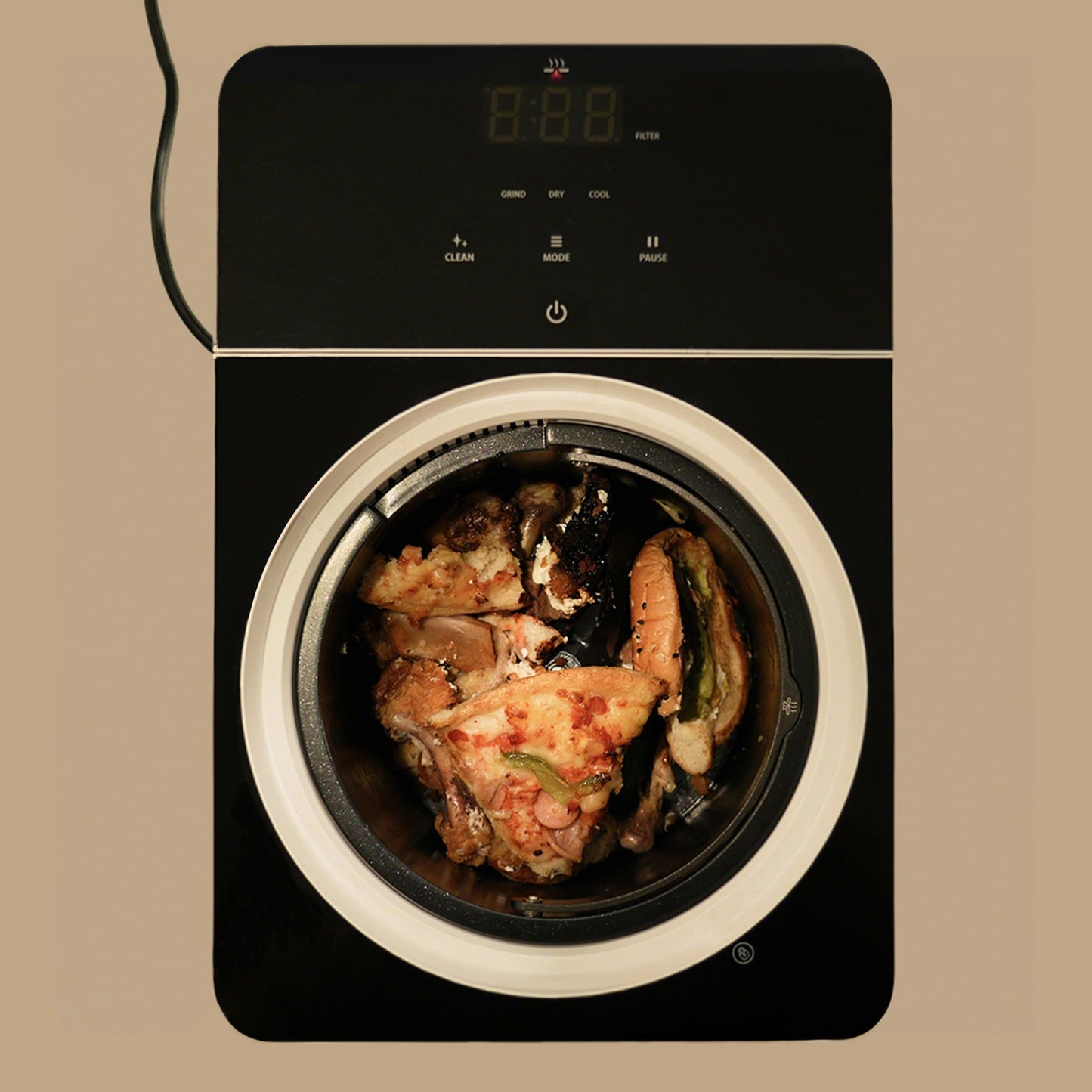
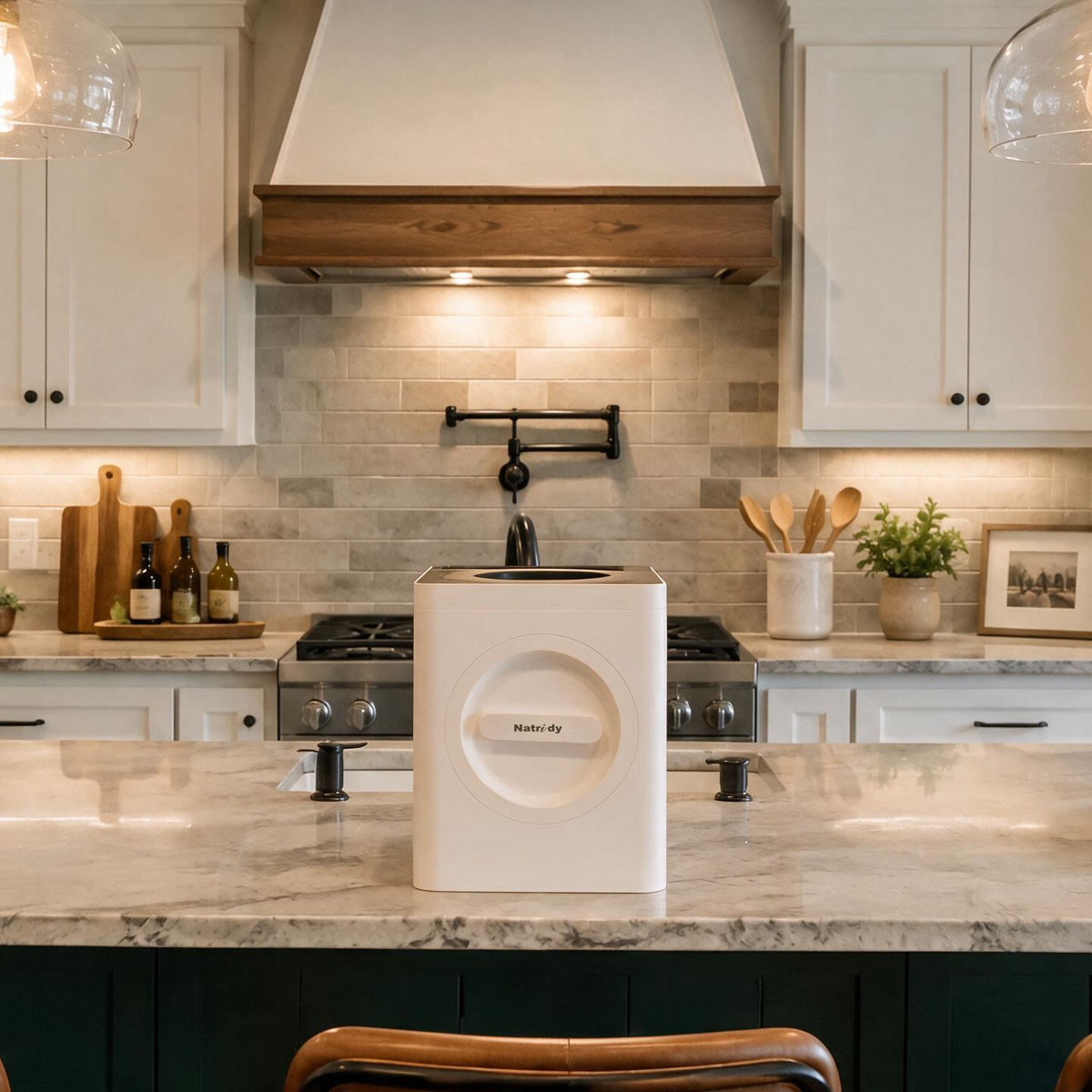
The Natridy Electric Composter produces dry, ground food-scrap material and carries a published claim of approximately 90% reduction by weight. That claim should not be generalized to every recipe, and it does not mean 90% of the food's matter is destroyed. Much of the measured change can be water leaving the batch.
Source: US EPA Approaches to Composting, retrieved August 28, 2026.
What a useful kitchen mass test records
Use a scale and a simple log:
| Measurement | Why it matters |
|---|---|
| Empty container mass | Lets you subtract the vessel |
| Wet input mass | Defines the starting basis |
| Broad food recipe | Explains variation between loads |
| Visible free liquid | Flags an unusually wet challenge |
| Completed dry-output mass | Defines the measured endpoint |
| Storage time and container | Separates processing from waiting |
Calculate: weight reduction = (wet input mass - dry output mass) ÷ wet input mass.
Any percentage needs its recipe and endpoint. A number without that context is difficult to reproduce or compare.
Why volume can fall differently from weight
Grinding changes particle size and packing. Drying changes mass and can shrink pieces. A powder can pack more tightly than whole scraps even if some dry solids remain.
That means "90% lighter" and "90% smaller" are not the same statement. Weight requires a scale; volume requires a defined container, fill method, and endpoint. Do not switch between the two because one number looks more dramatic.
A first-principles buyer question
Instead of asking, "How much waste disappears?" ask:
- How much wet mass can I load safely?
- How much water does my typical mix contain?
- What dry mass remains after the selected process?
- How often will I move that material to its destination?
- Which part of the result was measured by weight and which by volume?
This turns a marketing percentage into a household handling decision.
Continue with the output glossary, apartment odor storage guide, capacity claim framework, and the Natridy Electric Composter.
FAQ
What percentage of food scraps is water? There is no single valid household percentage. USDA data show that water is a measured component of food and varies by item. A bucket of melon and cooked vegetables differs from one containing bread, bones, coffee grounds, or dense leftovers. Measure the actual mix when the percentage matters.
Does drying remove the food waste? Drying removes water and changes handling. Grinding changes particle size. Food-derived dry solids remain and need a destination. EPA does not treat residential grinder/dehydrator output as finished compost merely because it is lighter, smaller, dry, or soil-like.
Why can two equally full buckets weigh different amounts? Volume describes occupied space; mass depends on density and water. Packing also matters. Loose peels can fill space with air gaps, while wet rice or dense leftovers can place more mass in the same volume. Compare working load, wet mass, and recipe separately.
Should I add liquid to reach the working capacity? No. A working-capacity figure is a maximum loading boundary, not a target that should be filled with liquid. Follow the supplied guide for supported inputs and moisture. Excess liquid can worsen processing, residue, leakage, and odor.