What Four-Week Capacity Actually Measures
This page covers one narrow question. For batch, capacity and emptying cadence, see the guide to the two electric composter designs.
A “four-week capacity” claim usually describes estimated time until a retained-material vessel reaches its fill line—not four weeks of unchanged raw scraps, daily throughput, or a guaranteed household schedule. To evaluate it, separate vessel volume, new input per cycle, accumulated processed inventory, and the variable time between emptying events.
One phrase can hide four different measurements
Capacity sounds like a single physical number. In a food-waste appliance, it can refer to four different things:
- Vessel volume: how much space the bucket or chamber contains.
- Input limit: how much new wet food the maker allows per cycle or day.
- Cumulative throughput: how much material the system processes across multiple additions.
- Time to empty: how long a particular household takes to reach a fill line.
Those measurements are connected, but they are not interchangeable. A large vessel is not automatically a high daily-input allowance. Forty pounds processed over weeks is not forty pounds stored at once. “Up to four weeks” is not a promise that every owner empties once every four weeks.
What Mill's four-week claim actually says
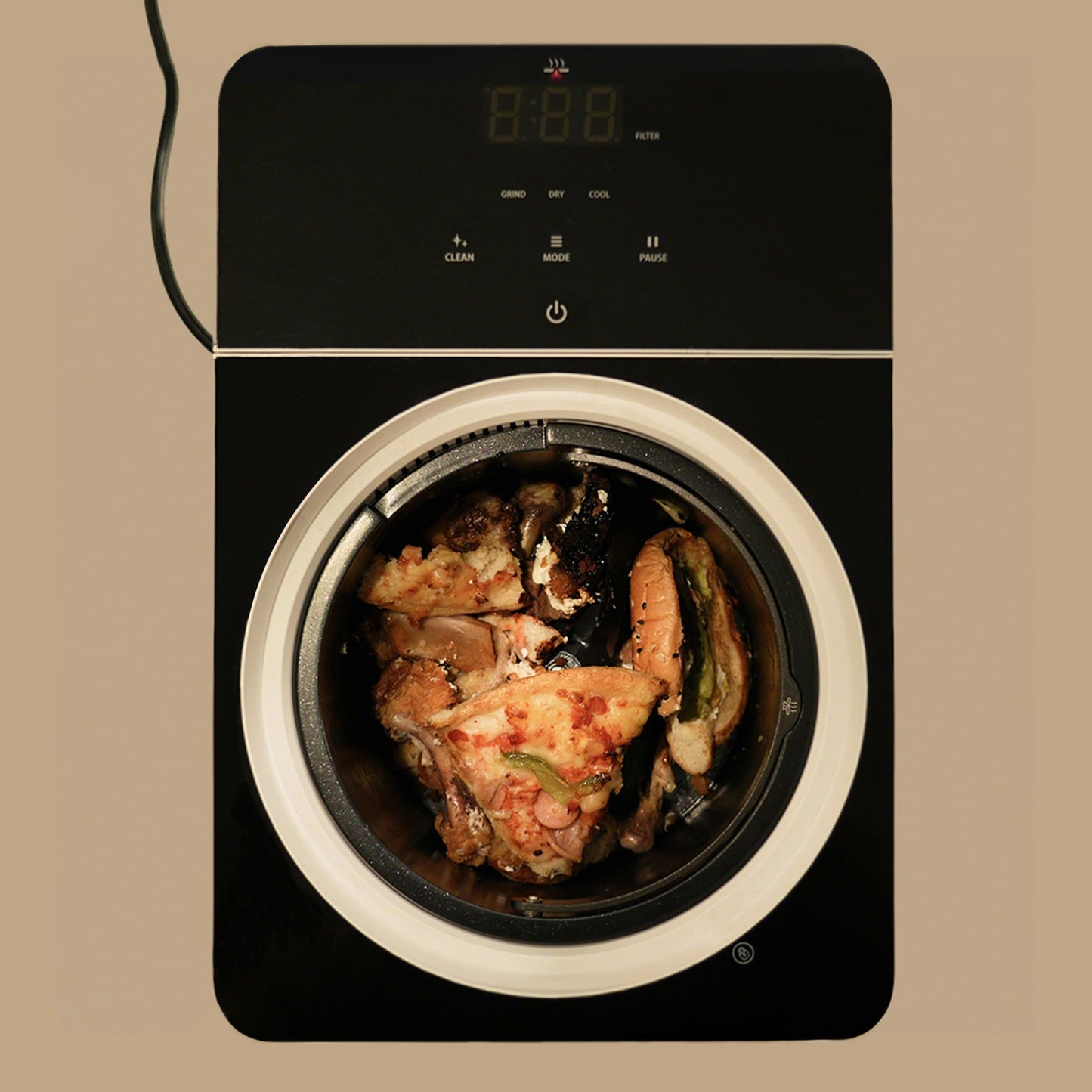
Mill's current product page advertises a 6.5 L bucket, 40 lb of food processed, 80% volume reduction, and “up to 4 weeks to fill.” Those are Mill-published marketing claims. The page does not disclose the input recipe, household size, starting moisture, or distribution of fill times behind the statements.
Mill's support pages add the operating context. New scraps are dried and ground during variable scheduled cycles while previously processed Food Grounds remain in the bucket. The owner empties when grounds reach the fill line.
Official timing language is not perfectly consistent. One Mill help page says the fill line usually takes “a couple weeks” for most households. Another says households using Mill pickups average four to six weeks, depending on the scraps they generate. The product page says up to four weeks.
That variation is not surprising. It shows why the fill line is the durable operating rule and the calendar interval is an estimate.
Sources: Mill product page, Dry & Grind guidance, emptying instructions, and Mill Pickups frequency guidance, retrieved August 27, 2026. These pages document manufacturer claims and prescribed routines, not an independent household study.
What remains inside during those weeks?
It is inaccurate to say one load of raw food simply sits unchanged for four weeks. Mill says each scheduled Dry & Grind event removes water and reduces new additions into Food Grounds. Earlier grounds remain while later inputs are added and processed.
The buyer-visible fact is narrower: food-derived material accumulates in the appliance between additions and emptying. Its state changes, but the vessel does not return to empty after every day's inputs.
That makes Mill a continuous-retention bin in Natridy's ownership taxonomy. Reencle belongs to the same high-level category for a different reason: it intentionally preserves an active bed between additions and harvests. Their mechanisms and emptying rules differ.
Read Mill vs Reencle for that distinction.
Why 6.5 L and 68 oz (2 L) are not a clean comparison
Mill's 6.5 L figure describes the bucket used for accumulating processed grounds plus new inputs. Natridy's 68 oz (2 L) figure describes a recommended working batch inside a 100 oz (3 L) drum. One is retained-system inventory; the other is a batch loading limit.
Putting the two numbers side by side without those labels would imply they measure the same job. They do not.
A fair ownership comparison asks:
- How much new wet food may be added in a defined period?
- What processing happens after each addition?
- How much processed material remains in the vessel?
- What tells the owner to empty it?
- Can the vessel return to empty between uses?
Those questions explain capacity more clearly than one headline volume.
A simple mass-balance model
Imagine a household adds a wet food mass each day. The appliance removes some water, releases some airborne compounds, and retains the remaining dry food-derived solids. The inventory inside on day seven depends on every prior addition minus everything removed from the vessel.
In plain terms:
retained inventory = cumulative additions − water and volatile losses − material emptied
This is an explanatory mass-balance model, not a Mill measurement. It shows why a four-week fill claim needs more than bucket size. High-moisture inputs may lose more mass than dry, dense inputs. Household feeding patterns and how completely the grounds settle also change the fill date.
Without the starting inputs and endpoint method, a marketer's weeks-to-fill number cannot become a universal household prediction.
What a defensible capacity test would publish
A useful test would disclose:
- household size or exact daily food-input mass;
- food recipe and starting moisture;
- number and duration of processing events;
- weight and volume remaining after each event;
- bucket fill-line definition;
- room temperature and humidity;
- every partial or complete emptying; and
- the number of days until the declared endpoint.
The result should be a distribution across multiple household patterns, not one best-case calendar number. It should also distinguish cumulative processed input from material physically retained at the end.
No such independent basis appears on the reviewed Mill pages. That does not disprove Mill's claim. It defines what the claim can and cannot establish.
Translate capacity into a kitchen routine
Choose a retained-material system if less-frequent emptying matters more than returning the vessel to empty. Accept that processed food-derived material remains in a powered floor bin and that fill level, airflow, odor control, and final grounds handling stay part of the routine.
Choose a finish-and-empty batch system if you want a defined load and removal event. Accept that you must plan batches and empty more frequently.
Choose neither if a Green Bin, freezer container, or outdoor compost system already makes storage and handoff easy.
The key comparison is not “large versus small.” It is empty each batch or retain material between additions.
FAQ
Does Mill keep raw food waste for four weeks? Not as one unchanged raw load. Mill says scheduled cycles dry and grind new additions into Food Grounds. Those processed grounds accumulate with later inputs until the fill line, which can take weeks depending on the household.
Does four-week capacity mean I empty exactly once a month? No. Mill's current pages use several estimates, including a couple weeks, up to four weeks, and a four-to-six-week average in one pickups context. The prescribed trigger is the fill line.
Is bucket volume the same as daily capacity? No. Bucket volume describes contained space. Daily capacity describes permitted new input over a time period. A retained bucket also contains processed material from earlier additions.
Can a 6.5 L retained bin be compared directly with a 2 L batch? Not as if the figures are the same measurement. The retained bin holds accumulated inventory; the batch number is a working load. Compare new input, processing schedule, retained inventory, and emptying cadence separately.