What a 24-Hour Food-Waste Breakdown Claim Actually Measures
A 24-hour food-waste breakdown claim sounds attractive because it turns a messy household problem into one clean number. But the number does not, by itself, tell you what remains inside, the age of every particle, when you can remove material, whether the removed material is ready for roots, or how much energy and maintenance the full routine requires.
Start with what the maker actually says
Reencle currently says that it can break down up to 90% of food waste within 24 hours. That is Reencle's published claim; it is not an independent measurement made by Natridy.
Source: Reencle FAQ, retrieved September 10, 2026.
The useful question is not whether the claim sounds fast. It is what event the clock stops on.
“Broken down” is not the same as “the vessel is empty”
Reencle is a retained-bed system. The owner adds a starter pack during setup, then adds food over time. The starter is included in the shipment but is an owner-added operating input, not installed biological hardware.
The maker's current feeding instructions tell owners to check that previous food has decomposed and to check the bed's moisture before adding more. They separately list a 14 L chamber for Prime and 22 L for Gravity models, while recommending up to 700 g per day for Prime and 1 kg per day for Gravity models. Chamber size and daily input are different measures.
Sources: Reencle Prime initial setup, Reencle Gravity initial setup, and Reencle daily capacity and feeding, retrieved September 10, 2026.
Because food enters on different days and ordinary emptying preserves part of the bed, the material inside can have mixed ages. A 24-hour change in one addition does not establish a 24-hour residence time for the entire inventory.
Ask six questions behind the speed number
| The headline says | The buyer still needs to know |
|---|---|
| “Up to 90%” | Ninety percent of which starting measure: mass, volume, visible pieces, or another endpoint? |
| “Within 24 hours” | What exact condition ends the clock, and under what food mix and load? |
| “Daily capacity” | Is that recommended input, maximum input, chamber volume, or actual harvested output? |
| “Continuous” | What material remains in the vessel between additions? |
| “Ready” | Ready to remove, ready to cure, ready to mulch, or independently shown ready for roots? |
| “Low maintenance” | What feeding, moisture, cleaning, filter, recovery, and harvesting work remains? |
This does not prove the headline false. It turns an attractive headline into a testable ownership claim.
Harvest timing changes the interpretation
Reencle's normal harvest instruction is not “empty after 24 hours.” It tells owners to wait until material reaches the MAX line, scoop only down to MIN, sieve the removed material, return undecomposed pieces, and continue operating with the retained bed.
Source: Reencle — When to Harvest, retrieved September 10, 2026.
That means breakdown time, time to MAX, harvest frequency, and the amount removed are four different numbers. The retention timeline guide shows why a daily input claim cannot stand in for an inventory history.
Fresh harvest and cured material are not the same sample
For planting or direct root contact, Reencle's current instructions say to mix four parts soil with one part harvested material, hold it in a breathable container for about three to four weeks, and mix it at least every three days. The page describes surface mulching separately.
Source: Reencle — Mulching vs Planting, retrieved September 10, 2026.
Reencle also publishes a Penn State laboratory result. Its own description says the tested composite combined three user samples that had each been cured outside the machine for about three to four weeks before analysis. That result concerns the cured composite sample. It does not establish that every fresh harvest has the same maturity, stability, pathogen status, or nutrient profile.
Source: Reencle Compost Test Results, retrieved September 10, 2026.
Energy and odor belong in the same ownership review
Reencle's current specifications publish average energy use of 1.25 kWh per day for Prime and 1.13 kWh per day for Gravity and Gravity Pro. Those are maker-reported daily figures. Compare them with another machine only across the same observation period, supported food load, final material state, and retained inventory.
The same principle applies to odor. Reencle recommends carbon-filter replacement every nine to 12 months, while also telling owners to watch for sour or stale odor near the rear vent and to maintain bed moisture, internal cleanliness, and the mesh filter. A calendar recommendation is not a disclosed carbon-capacity or breakthrough test.
Sources: Reencle model specifications and Reencle Prime carbon filter, retrieved September 10, 2026.
What the 24-hour claim is useful for
The claim can be useful as a maker-stated estimate of visible or described breakdown under its intended operating conditions. It is not, alone, an emptying schedule, an inventory age, a harvest yield, a curing endpoint, an energy comparison, or independent evidence that every removed sample is ready for every destination.
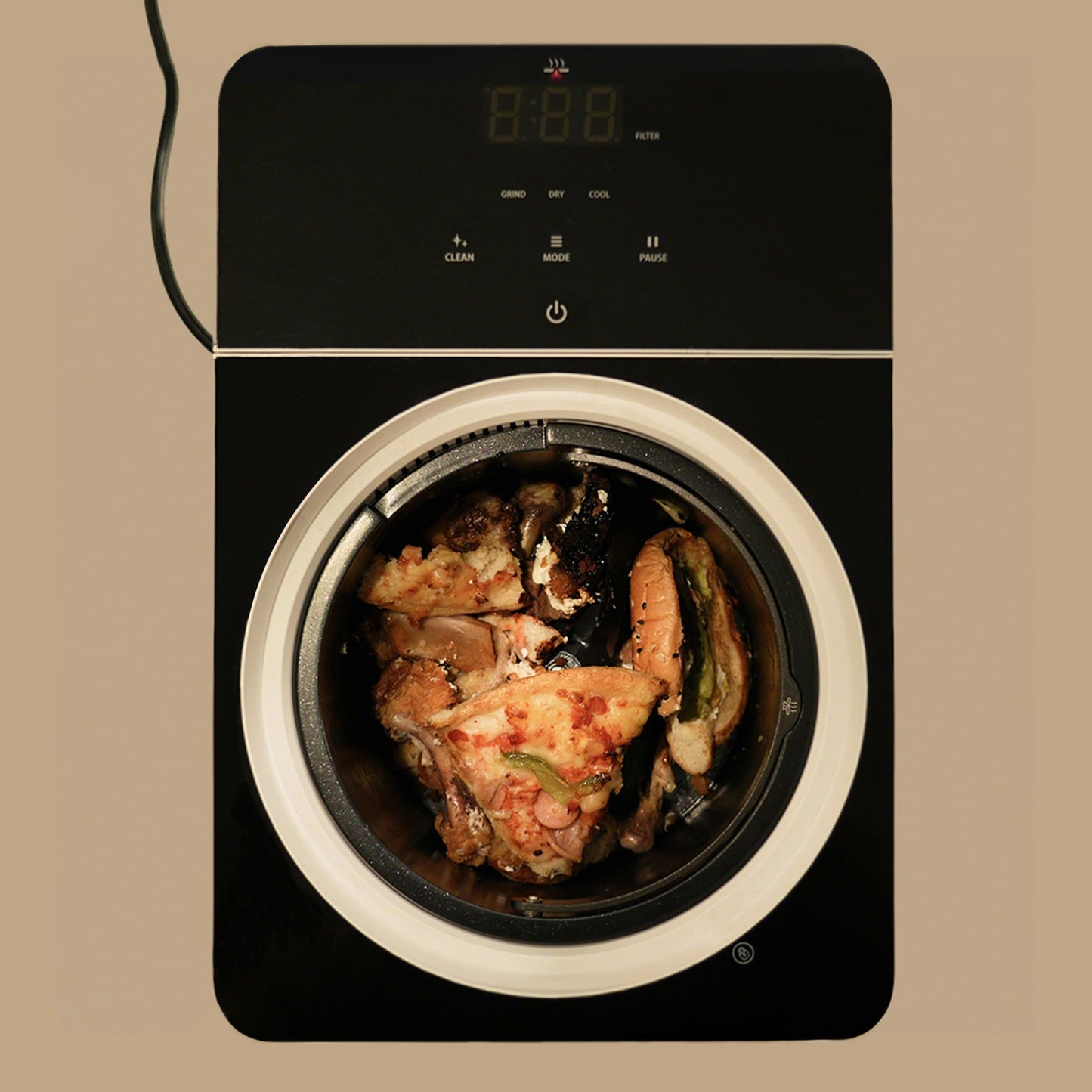
A finish-and-empty dryer-grinder answers a different household question. The Natridy Core Unit processes a selected batch and can return to an empty vessel after the cycle. Its result is dry, ground food-scrap material, not finished compost. Compare that batch routine with Reencle's retained-bed routine before comparing a four-hour cycle with a 24-hour breakdown statement.
FAQ
Does Reencle empty itself after 24 hours? No. Reencle's normal routine retains material in the chamber. Owners add food over time and harvest only after the bed reaches MAX, removing material down to MIN and leaving the rest in place. A 24-hour breakdown claim is not a 24-hour emptying instruction.
Does 90% breakdown mean 90% of the chamber disappears? The headline alone does not establish that interpretation. Ask for the starting measure, test load, endpoint, and remaining inventory. Chamber volume, daily input, visible-food change, retained-bed mass, and harvested output are separate measures.
Is fresh Reencle material ready for roots after 24 hours? Reencle's current planting instructions require about three to four weeks of curing in a breathable four-parts-soil-to-one-part-harvest mixture before direct root or seed contact. Surface mulching is described separately. A fresh harvest and a cured sample are not the same endpoint.
How should I compare a 24-hour retained-bed claim with a four-hour batch cycle? Do not compare the clock labels alone. Match the food mass and moisture, observation period, energy at the wall, material remaining inside, amount removed, output condition, maintenance, and destination. Cycle time and retention time answer different questions.