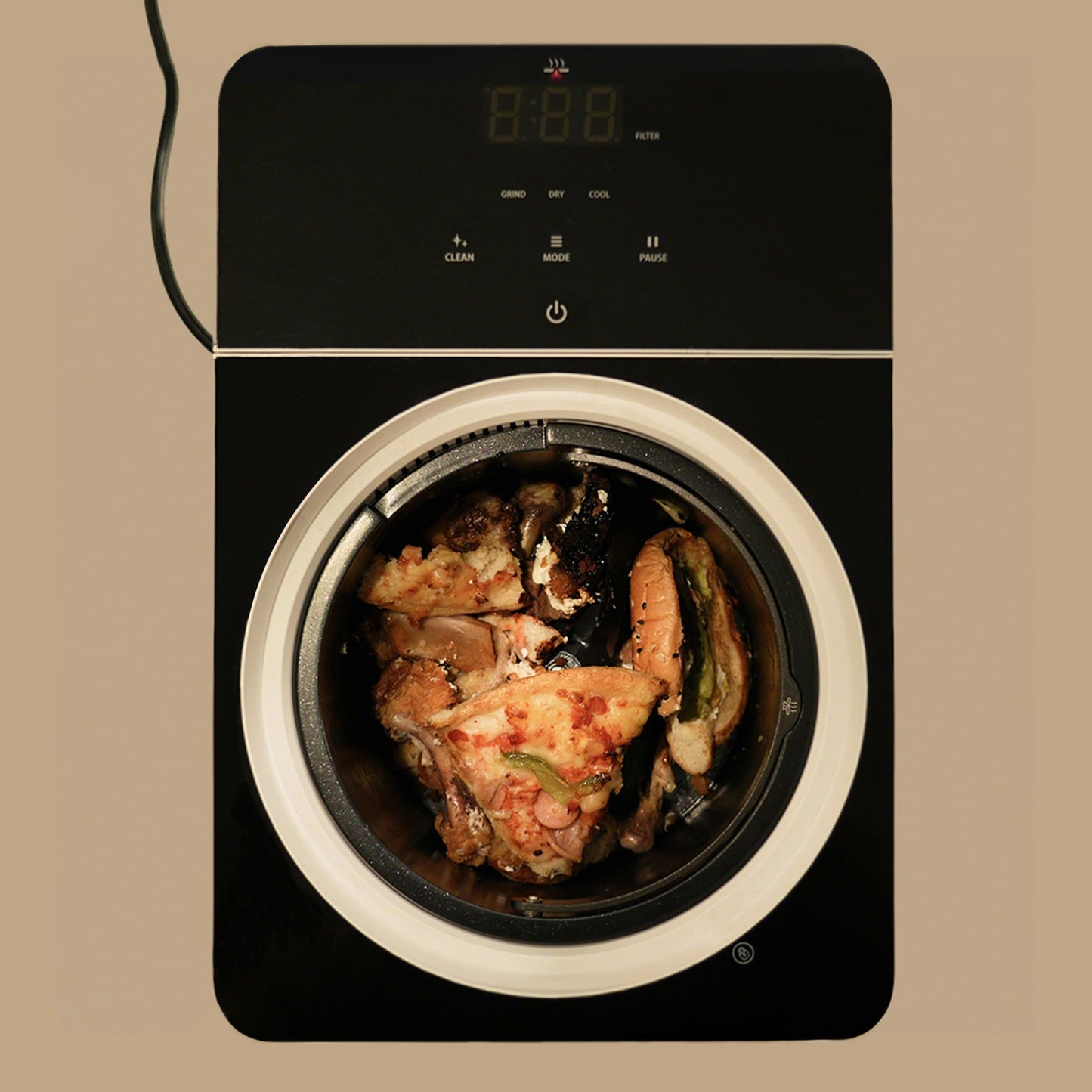
What Is Still Inside a Food-Waste Machine After 1, 7, and 28 Days?
A day label describes vessel inventory, not the age or condition of every food particle. A batch machine can return to empty after one chosen load. Mill retains accumulated dry Food Grounds until its fill line. Reencle retains an owner-established bed across additions and harvests. These are different inventories, not one universal decomposition timeline.
Day one: ask what the vessel is designed to retain
Finish-and-empty batch machine
The owner loads a supported batch, completes a cycle, and removes the dry result. If emptied and cleaned as directed, the vessel can contain no intentional food-derived inventory before the next load.
Mill
Mill says scheduled Dry & Grind processing changes new additions into Food Grounds. Grounds from earlier additions remain in the bucket while later scraps are added.
Reencle
Reencle instructs the owner to establish a starter bed, keep the unit powered, and add food over time. The bed remains part of the prescribed routine.
The first non-obvious fact is that "inside after one day" is an ownership choice. It is not simply a measure of processing speed.
Day seven: inventories begin to diverge
After a week, a batch owner may have completed and emptied several independent loads. The machine does not need to retain the combined week's output.
Mill may contain a mixture of processed grounds from several additions plus newer material at different processing stages. Mill says Dry & Grind generally takes 3–8 hours and varies with amount, density, moisture, and additions. That supports a changing inventory, not the claim that raw food sits unchanged for seven days.
Reencle's vessel still contains the retained bed plus material added at different times. The maker publishes daily feeding and moisture instructions, but those do not identify the age of each particle.
Sources: Mill Dry & Grind tips and Reencle daily feeding, retrieved August 28, 2026.
Day 28: a marketing interval is not a material census
Mill's product page uses an "up to four weeks to fill" frame. Its current emptying support says most households reach the fill line in a couple of weeks. The reliable operational trigger is the fill line; household timing varies.
At 28 days, one Mill may already have been emptied while another may still hold accumulated Food Grounds. The interval does not prove that the oldest particle is 28 days old, that every addition was retained for 28 days, or that material remained raw.
Reencle's harvest routine is different. It tells owners to remove excess material from MAX only down to MIN, preserving the bed. A 28-day snapshot therefore includes intentional retained material even after a harvest.
Sources: Mill emptying, and Reencle harvest, retrieved August 28, 2026.
Timeline table
| Time | Finish-and-empty batch | Mill retained grounds | Reencle retained bed |
|---|---|---|---|
| After a completed event | Dry batch can be removed | New input may be processed while earlier grounds remain | Bed and mixed-age material remain |
| Around 7 days | Several separate batches may have returned the vessel to empty | Accumulated processed inventory may be below the fill line | Ongoing additions share the chamber with the retained bed |
| Around 28 days | No intentional 28-day inventory if each batch was emptied | Bucket may have been emptied already or may still be filling | Harvest may remove excess, but prescribed MIN bed remains |
This table describes prescribed routines, not measurements of every household.
Why particle age cannot be inferred
Mixing, grinding, drying, new additions, partial removal, caking, and harvest make the vessel a mixed system. A label such as "four-week bin" describes a household emptying frame, not a tracking tag attached to each scrap.
These calendar snapshots describe the material remaining in the vessel. They cannot establish the residence time of individual scraps without tracking additions, mixing and removals.
What retained inventory changes
Keeping food-derived material inside can reduce emptying frequency. It also makes the vessel's moisture, airflow, mixing, odor source, carbon, floor space, and cleaning part of an ongoing system.
Returning a batch vessel to empty creates more frequent handling but a visible reset. Neither is automatically better. Buyers should choose which inventory they want in the kitchen.
Read Mill vs Reencle for the mechanism differences inside the retained category.
A fair observation test
A real timeline study would:
- Weigh and label each addition.
- Record moisture and broad food recipe.
- Log processing events and energy.
- Sample material at defined vessel locations.
- Record every emptying or harvest mass.
- Track odor and carbon with one disclosed method.
- Avoid claiming particle age where mixing destroys identity.
Until such data exist, a vessel timeline is a routine map, not a decomposition verdict.
Compare the two ownership systems, cycle versus retention clocks, the Mill-Reencle routine split, and the Natridy Electric Composter.
FAQ
Does Mill keep raw food waste for four weeks? That wording is too crude. Mill says scheduled cycles dry and grind new additions while processed Food Grounds accumulate until the fill line. Food-derived material remains in the vessel, but its state changes. Mill's current pages also describe variable household fill intervals.
Is Reencle's retained material built into the machine? No. The microbial starter is an input the owner adds during setup, not machine hardware. Reencle's instructions then require the retained material to remain at or above MIN after harvesting. That prescribed routine does not by itself prove the condition or age of every particle.
Can a batch machine contain a week's scraps? A household may collect scraps before running or store dry output afterward, but that storage is a separate choice. The finish-and-empty machine itself can return to empty after each completed batch. Do not confuse household collection time with processing or vessel-retention time.
Why compare 1, 7, and 28 days if particles are not tracked? The snapshots expose the ownership model. They show whether the vessel is designed to reset or to retain mixed-age material. They do not establish biological stability, odor performance, or exact particle residence without controlled measurements.