Who Should Choose a Continuous-Retention Food-Waste Bin?
Choose a continuous-retention food-waste bin if you value frequent additions more than a clean empty reset and are comfortable managing retained material, scheduled or continuous operation, filters, owner checks, and a less frequent removal event. Choose a batch machine if you prefer one load, one finish point, and a visible reset.
“Continuous” describes ownership, not one mechanism
Mill and Reencle both retain material between additions, but they handle removal differently: Mill’s bucket is emptied, while Reencle’s ordinary harvest preserves a starter bed.
- Mill dries and grinds scraps during recurring scheduled cycles, while processed Food Grounds accumulate until the owner empties the bucket at its fill line.
- Reencle tells owners to add a separate starter, preserve a retained bed at or above MIN., assess prior input and moisture, and harvest material from MAX down to MIN.
Sources: Mill scheduling tips, Mill emptying guidance, Reencle feeding guidance, and Reencle harvest guidance, retrieved September 8, 2026.
These are maker instructions. They document the intended routines, not independently verified throughput, odor, microbial activity, particle residence time, or output maturity.
The first decision is the reset point
Ask what “done” should look like in your kitchen.
| Ownership type | Addition pattern | Ordinary reset |
|---|---|---|
| Continuous retention | Add new scraps before all prior material leaves | Empty accumulated grounds at a fill line, or harvest while preserving a bed |
| Finish-and-empty batch | Choose a load, process it, then remove the result | Removable vessel can return to empty after that batch |
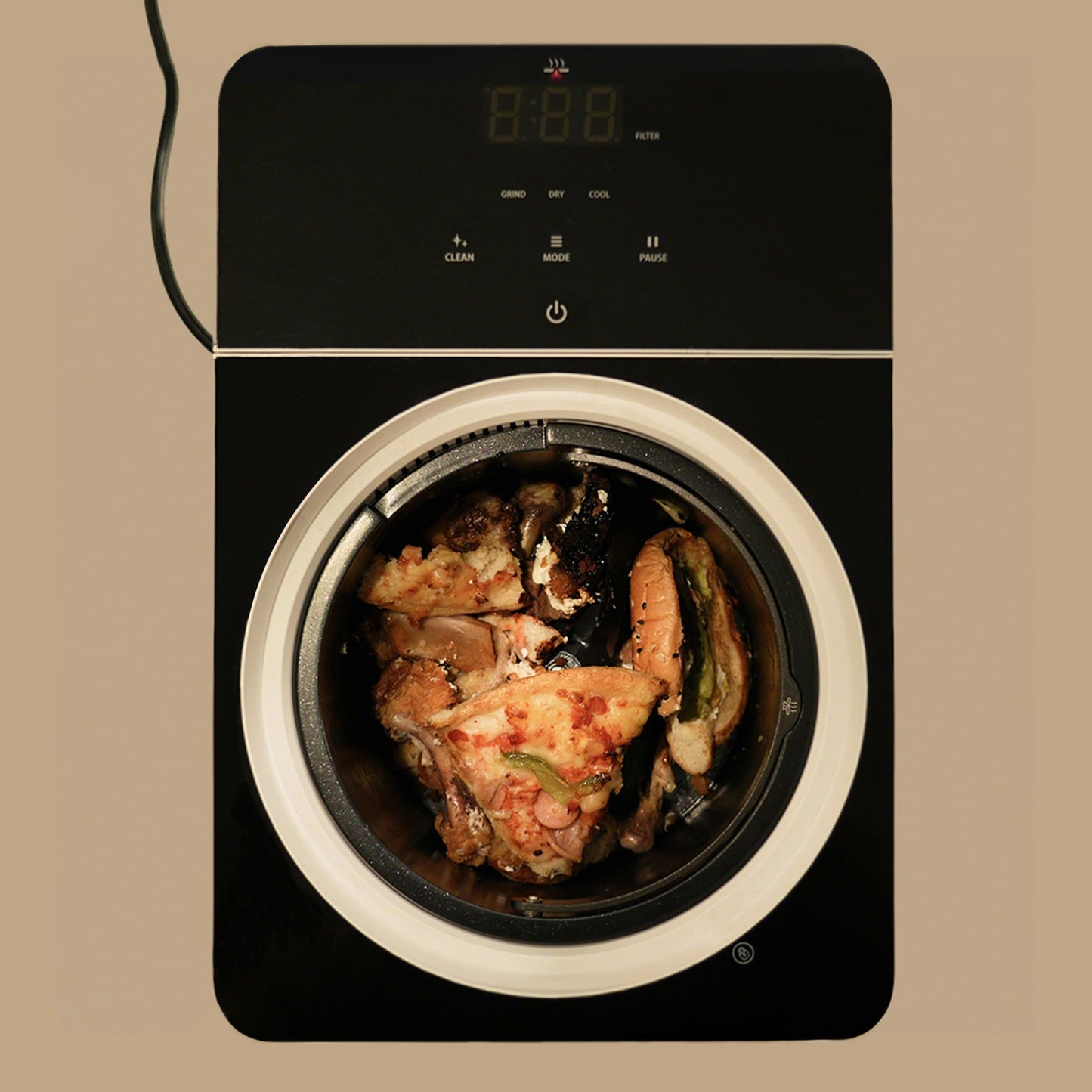
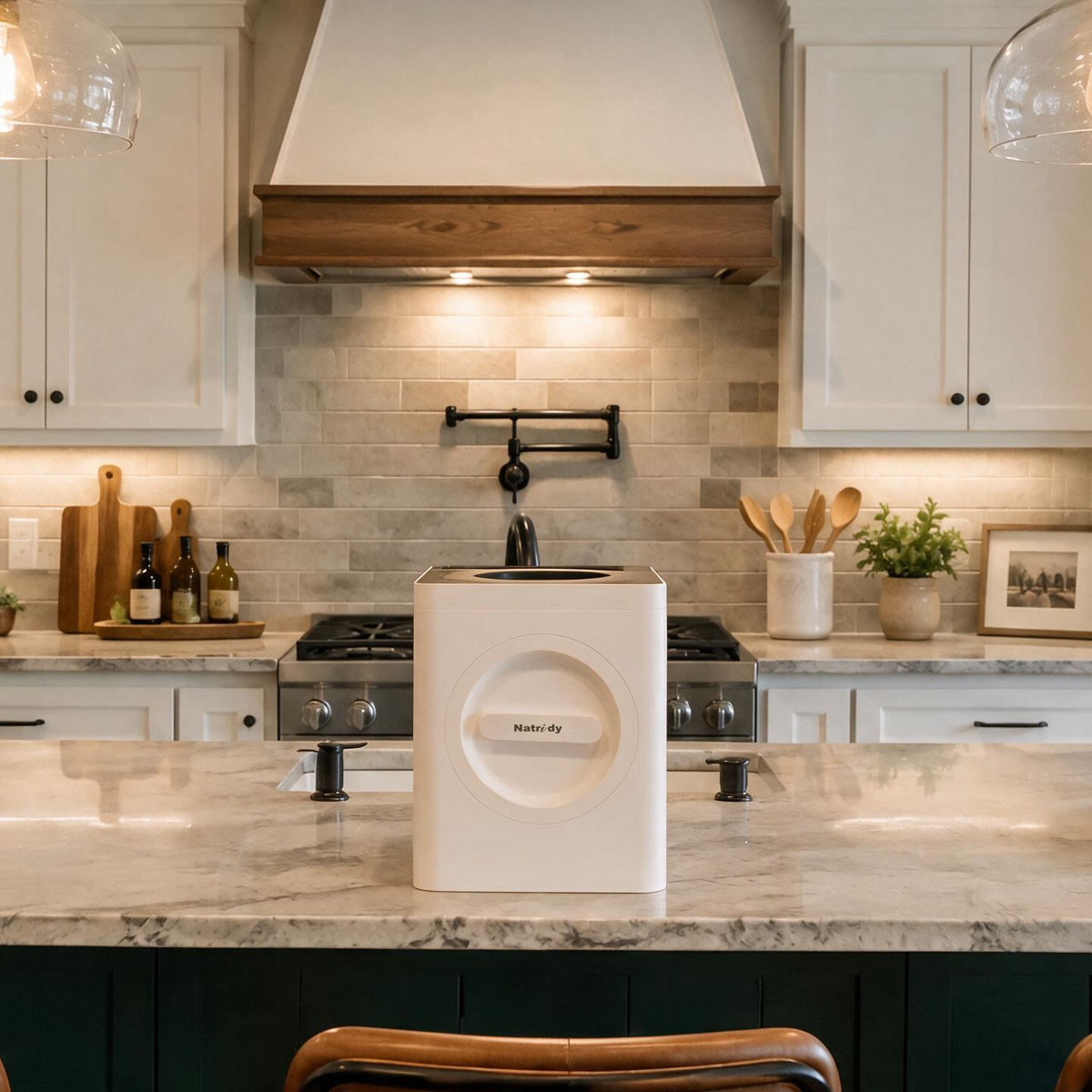
The Natridy Electric Composter uses a finish-and-empty batch boundary. It dries and grinds supported food scraps; its result is not finished compost or fertilizer.
Continuous retention is attractive when the owner wants to open a lid and add today's scraps without first clearing yesterday's material. The tradeoff is that the appliance becomes ongoing food-waste infrastructure rather than a tool used for one selected batch.
A continuous-retention bin may fit you if…
You prefer frequent additions
Mill says owners can add scraps during a Dry & Grind cycle. Reencle provides a daily-feeding routine subject to prior-input and moisture checks. The specific gate differs, but both reduce the need to build a separate complete batch before loading.
That convenience is valuable only if the supported-input rules match the household's real scraps. Track what gets rejected, drained, cut, or routed elsewhere.
You accept retained inventory indoors
Mill says most households reach its fill line after a couple weeks. Reencle's ordinary harvest preserves material down to MIN. Neither statement establishes the exact age of each particle, and the routines should not be described as mechanically identical.
The owner-facing fact is enough for a decision: some material remains in the appliance across multiple additions. If that feels simpler than emptying each processed batch, continuous retention may fit. If you want to see and clean an empty vessel frequently, it may not.
You have dedicated floor space and service clearance
Reserve room for the operating footprint, lid movement, bucket or harvest access, filters, and the path to carry removed material. Do not forget the existing trash, recycling, and organics containers.
Measure the actual kitchen and follow the exact model's electrical and ventilation instructions. Product photography is not a clearance plan.
You will maintain the source and air path
Carbon is only one layer of odor management. Retained material condition, residue, seals, airflow, dust or mesh loading, carbon media, humidity, and the service endpoint can all matter.
Mill tells owners to clean a dust filter and uses a separate carbon filter. Reencle tells owners to assess bed moisture and states that its higher-fan Purify mode does not correct underlying moisture, cleanliness, or input-balance causes.
Sources: Mill Dry & Grind tips and Reencle Prime controls, retrieved September 8, 2026. These model-specific instructions do not establish problem frequency or cross-brand performance.
You are comfortable with ongoing power
Recurring cycles or continuous powered operation should be evaluated over the same food-input and removal window. Record plug energy, supported scrap mass, moisture-heavy loads, idle days, and output removed.
A maker's daily average cannot be compared fairly with another machine's per-cycle number until the loads and time windows match. The Mill ownership guide and Reencle ownership guide explain each model’s power use and daily care.
A batch machine may fit you better if…
Choose a finish-and-empty batch when you prefer to:
- select exactly which supported scraps enter the load;
- see a distinct start and finish;
- remove all processed material after the cycle;
- inspect and clean an empty removable vessel; or
- leave the appliance unused between chosen cycles.
Batch operation is not automatically lower-work or lower-energy. Large, wet, sticky, or unsuitable loads can still demand preparation and cleaning. The advantage is legibility: the owner can point to one batch boundary and one reset.
Five comparisons that marketing labels hide
1. Cycle time versus retention time
A processing claim describes a machine event. Retention describes how long material remains before removal. Record both.
2. Chamber size versus supported input
Internal volume does not equal recommended daily input, comfortable working batch, or verified throughput. Keep each unit and condition attached.
3. Filter interval versus odor endpoint
A month range or app estimate schedules service. It does not prove remaining adsorption capacity without a defined source load, air path, and breakthrough threshold.
4. Removed material versus destination
Dry grounds, retained-bed harvest, municipal organics, garden finishing, and trash are different routes. Ask what leaves the machine and what must happen next.
5. Automation versus owner checks
A scheduled cycle can coexist with dust-filter cleaning and fill-line emptying. A marketed biological process can coexist with moisture checks, feeding pauses, and harvest instructions. List every repeated owner action.
Run a one-week paper trial
Before buying, use a container and a simple log:
- Weigh supported scraps each day.
- Record when you would add them and when a cycle would run.
- Mark wet, fibrous, oily, hard, or excluded items.
- Reserve the appliance footprint.
- Schedule every filter, cleaning, bed check, and emptying action from the maker guide.
- Name the final destination for removed material.
Then score the routine on friction, not novelty. The best category is the one the household will still operate correctly after the launch week.
For a deeper mechanism comparison, read Mill versus Reencle: retained-material routine.
FAQ
What is a continuous-retention food-waste bin? It is a food-waste appliance that retains material between additions. Mill accumulates dry grounds until emptying; Reencle maintains a microbial starter bed through repeated feeding and partial harvests.
Does continuous retention mean scraps sit unchanged? No. The term does not describe the state of every particle. Mill says it dries and grinds during scheduled cycles; Reencle describes a retained-bed process. Both appliances retain material between additions. Age, moisture, and transformation require separate evidence.
Is a continuous bin more convenient than a batch machine? It can be for households that value frequent additions and less frequent full emptying. The tradeoff is ongoing retained inventory plus model-specific power, filter, cleaning, checking, and removal work. Convenience depends on which repeated tasks fit the owner.
Can I compare these machines by daily capacity alone? No. Compare supported inputs, chamber or working volume, loading schedule, moisture, processing window, retained inventory, power, service work, and removed output on the same basis. A single daily number cannot describe the complete ownership loop.