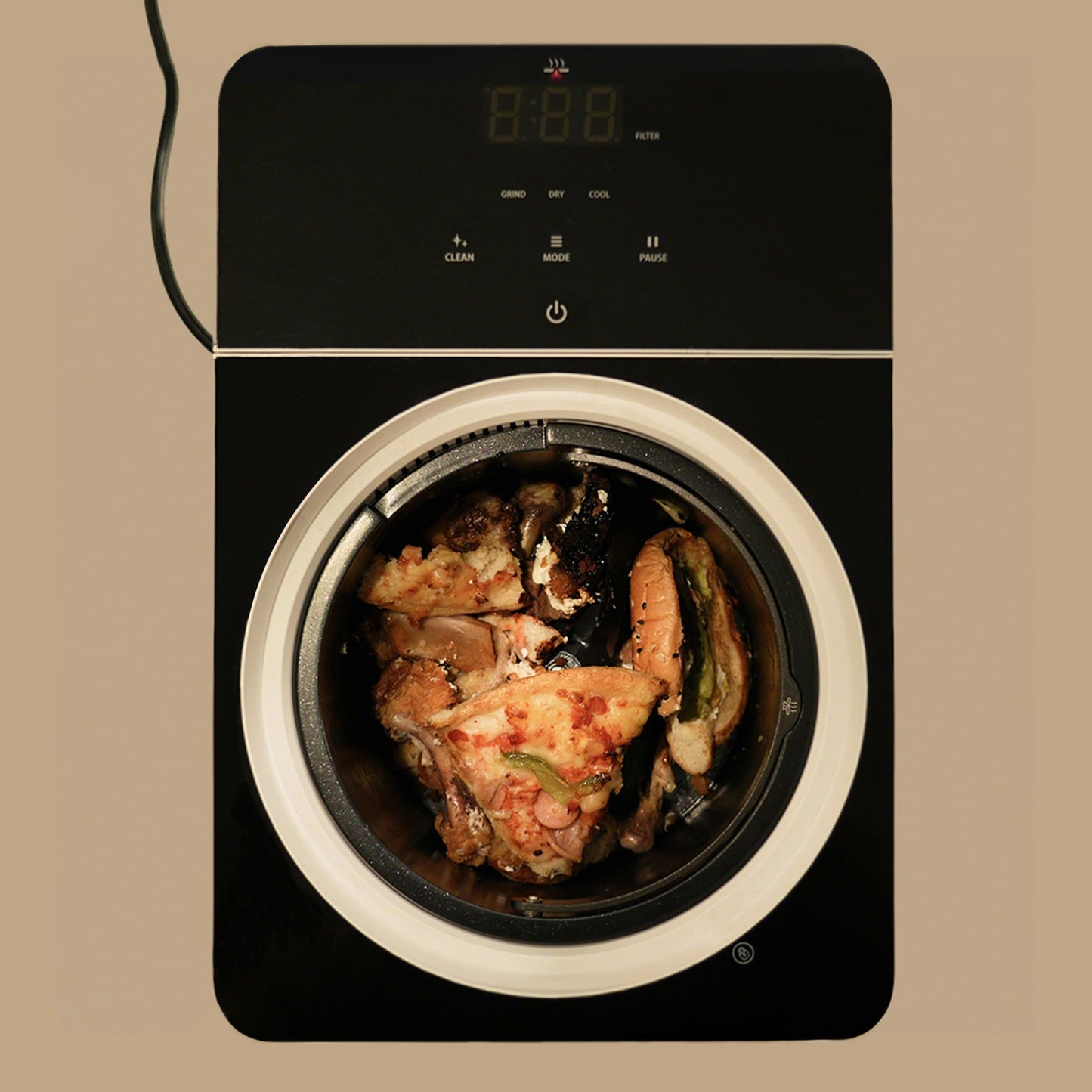
The Mill Ownership Routine: Floor Space, Daily Power, Filters, and Emptying
Mill ownership centers on a recurring scheduled cycle and an accumulating bucket of dry grounds. The maker tells owners to add scraps between emptying events, run scheduled Dry & Grind cycles, maintain the dust and carbon filters, and empty at the fill line. Evaluate that whole routine—not one cycle-time or bin-size number.
Start with the repeated routine
Mill says its food recycler is designed to run daily at a scheduled start time. Owners may change the schedule or manually start and stop a cycle, but the current support page says scheduled cycles cannot be removed altogether. It also permits adding scraps while a cycle is running.
Source: Mill Dry & Grind scheduling tips, retrieved September 1, 2026. These are maker instructions, not observations of every household.
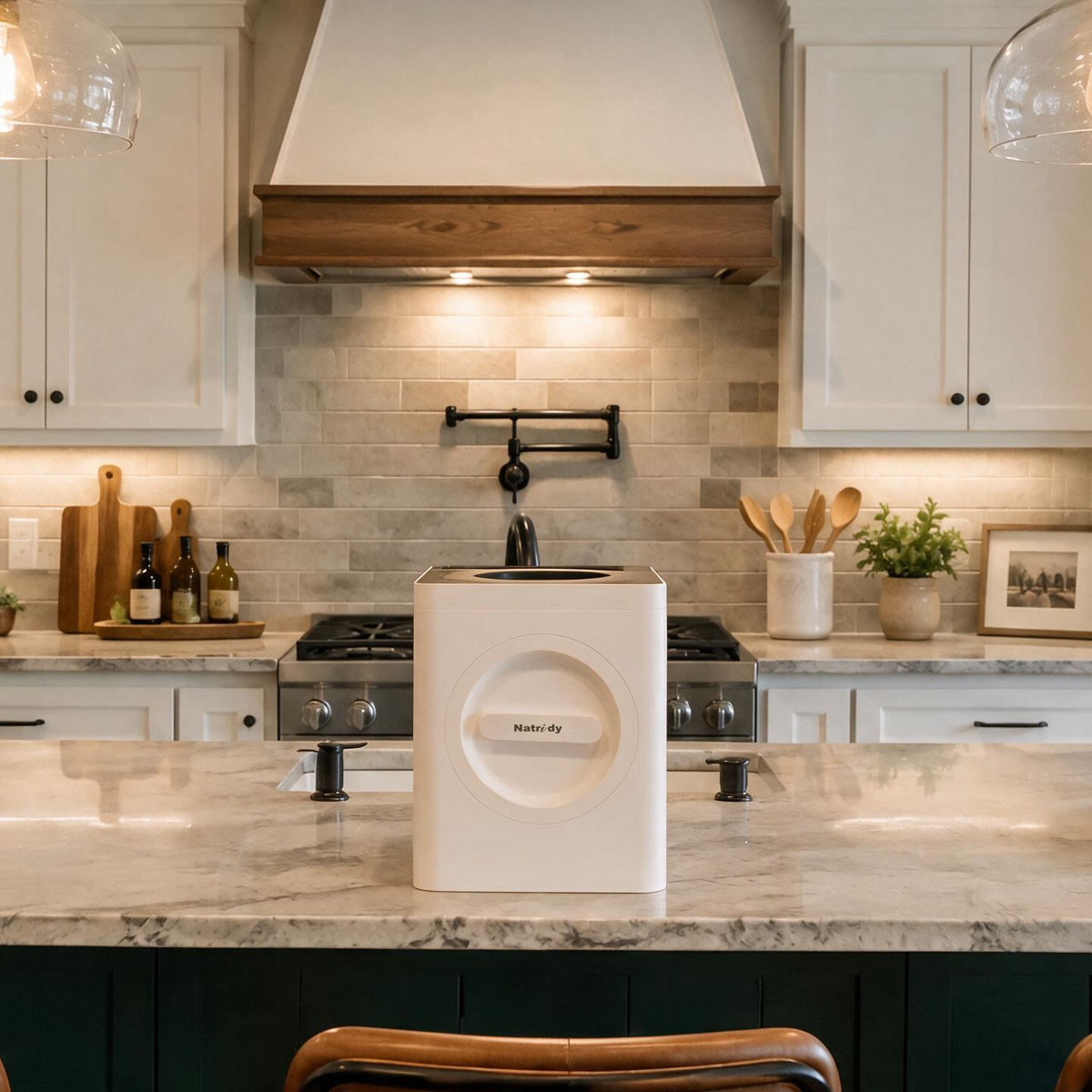
That creates a different ownership boundary from a chosen-batch appliance. With Mill, new inputs can join material already in the bucket before the next full emptying event. With a finish-and-empty machine such as the Natridy Electric Composter, the owner can return the removable vessel to empty after a selected batch.
Neither routine wins by definition. The useful question is which inventory and schedule you want to manage in the kitchen.
Daily cycle is not the same as daily emptying
Mill describes a cycle that slowly heats and mixes scraps. It says cycle duration varies with the amount and moisture of the food, and that air leaves through an exhaust system that includes a carbon filter.
Source: How a Mill cycle works, retrieved September 1, 2026. “Food Grounds” is Mill's name for the dried, ground material. It is not an independent finding about compost maturity, storage life, or odor performance.
The distinction matters:
| Measure | What it describes | What it does not prove |
|---|---|---|
| Cycle duration | Time for one scheduled Dry & Grind run | Time until the bucket is emptied |
| New scraps per cycle | A maker-stated input limit or example | Actual household throughput under every food mix |
| Fill line | The maker's emptying trigger | Age of every particle in the bucket |
| Emptying interval | Time between full bucket removals | Carbon capacity or food-safety status |
A short processing cycle and a multi-cycle storage routine can both be true. Compare them as separate clocks.
Power belongs beside the food load
Mill publishes around 0.7 kWh per day as an average for drying and grinding scraps from a family of four. The same page says power depends on the amount of scraps and advises limiting liquids. It also says wetter loads and late mid-cycle additions can extend processing.
Source: Mill Dry & Grind scheduling tips, retrieved September 1, 2026. This is Mill’s published estimate. The public page does not disclose the household sample, food recipe, ambient conditions, meter record, or distribution behind the average.
For an ownership comparison, meter electricity across the same observation window as food added and grounds removed. “Per day” without a matching mass and moisture load is not a same-basis efficiency result.
The bucket accumulates material across cycles
Mill tells owners to empty when the Food Grounds reach the fill line. Its support page says this usually takes a couple of weeks for most households. An app and lid-light reminder appears when the grounds weigh at least 6.5 lb after a cycle, which Mill says usually indicates the bucket is getting full. The maker also instructs owners to let the grounds dry and cool before removal.
Source: How to empty your Mill, retrieved September 1, 2026.
“A couple of weeks” is maker guidance, not a promise for every household and not the residence time of each scrap. A light triggered by weight is also not identical to the visual fill line. The safe conclusion is narrower: processed material is intentionally retained across multiple cycles before the ordinary full-bucket emptying event.
That is why our Natridy versus Mill comparison separates cycle time from retention time.
Filters are two different maintenance jobs
Mill's cycle guidance tells owners to clean the dust filter, comparing the action with wiping a dryer lint trap. Mill separately uses a carbon filter in the exhaust path.
Its Filter Status page says the app estimates service from Dry & Grind processing hours. It gives different typical filter-life ranges for Mill Plus and Mill Essential and says results vary with use and scraps.
Sources: Mill Dry & Grind scheduling tips and Mill Filter Status, retrieved September 1, 2026.
A processing-hours estimator is more specific than an unexplained calendar, but it is still not a published carbon-breakthrough test. It does not disclose the food-odor load, airflow, humidity, carbon activity, or failure threshold needed for a controlled comparison. Use our odor-claim evaluation guide to test that evidence chain.
Floor placement changes the kitchen plan
A floor-bin appliance asks for more than a width-and-depth measurement. Check:
- the operating footprint and lid-opening clearance;
- access to a suitable outlet and the maker's ventilation clearances;
- the route for carrying a removable bucket when it is full;
- clearance for filter and dust-filter service;
- how the appliance coexists with the household's trash, recycling, and organics bins; and
- the permitted destination for removed grounds.
Measure the intended location rather than judging from a product photograph. Keep manufacturer clearance and electrical instructions attached to the exact model.
A seven-day ownership trial before buying
You can model the routine without owning the appliance:
- Weigh the supported scraps your household would add each day.
- Note moisture-heavy meals and drain free liquid where appropriate.
- Mark the time you would want a scheduled cycle to start.
- Reserve the proposed floor space and simulate opening and service access.
- Estimate how often accumulated dry material would need a permitted handoff.
- Price carbon and other consumables by the same usage window, not by headline months.
This trial will not predict product performance. It reveals whether the prescribed ownership rhythm fits the kitchen.
Compare the reset you want
Mill and Reencle both raise a continuous-addition ownership question, but their internal routines are not mechanically identical. Mill accumulates dried Food Grounds across scheduled cycles; Reencle prescribes a retained starter bed with moisture checks and MAX-to-MIN harvesting. See the retained-material comparison.
Natridy uses a discrete batch boundary: add a chosen load, run the process, remove the dry grounds, and return the bucket to empty. The decision is not “advanced” versus “basic.” It is whether you want ongoing retained inventory or a visible reset after each batch.
FAQ
Does Mill empty itself after every Dry & Grind cycle? No. Mill tells owners to add scraps across recurring cycles and empty the removable bucket when the Food Grounds reach the fill line. Its current support page says that usually takes a couple weeks for most households, but actual timing depends on use.
Does Mill use exactly 0.7 kWh every day? No. Mill publishes around 0.7 kWh per day as an average for scraps from a family of four and says usage depends on the load. A same-basis comparison should meter energy alongside food mass, moisture, operating days, and removed output.
Does Mill's Filter Status prove the carbon still controls odor? No. Mill says Filter Status uses processing hours to estimate service timing. That is a maintenance model, not a disclosed inlet-to-outlet breakthrough test. Source load, airflow, humidity, carbon properties, cleaning, bypass, and the chosen odor endpoint still matter.
Is Mill the same kind of machine as Reencle? Both retain material between additions. Mill is emptied when accumulated grounds reach the fill line; Reencle’s ordinary harvest preserves a starter bed at or above MIN. Their prescribed mechanisms differ. Mill dries and grinds into accumulated Food Grounds; Reencle uses an owner-added starter and MAX-to-MIN retained-bed routine. Compare both the common ownership boundary and the distinct instructions.