How to Evaluate Indoor Food-Waste Odor Claims Without Trusting a Calendar
A filter calendar is a maintenance reminder, not an odor-performance result. Evaluate the food source, moisture and time, the route air actually takes, the carbon medium, operating conditions, and a defined breakthrough endpoint. A fair claim states where odor was measured, under what load, and whether the result came from instruments, people, or both.
First define what the claim means
"Odor-free," "less odor," "no detectable exhaust odor," and "replace every six months" are not the same claim. Before comparing products, define:
- the location: inside the vessel, at the exhaust, or in the room;
- the phase: storage, active processing, cooling, or post-process handling;
- the observer: an instrument, a trained or blinded panel, or an owner; and
- the endpoint: odor intensity, a named compound, or a maintenance threshold.
Perceived odor is not automatically an indoor-health test. Odor thresholds, measured concentrations, and exposure limits answer different questions.
Step 1: characterize the source load
Food type, mass, initial condition, moisture, storage time, and temperature all shape the source a control system must handle. A two-week experiment on green food waste in adapted household bins reported that volatile profiles depended strongly on the waste material, changed with temperature and time, and were affected by aeration.
Source: Agapiou et al., volatile emissions from stored green food waste, retrieved August 31, 2026. This was a small experiment in modified bins, not a countertop-appliance test, carbon-life test, or household odor panel. It supports recording source conditions; it does not rank products.
Cornell explains that excess moisture can fill pore space and slow oxygen penetration in composting material, creating conditions associated with odorous emissions. It also notes that fermentation and some aerobic processes can generate odors.
Sources: Cornell excess-moisture guidance and Cornell odor management, retrieved August 31,
- These pages concern compost matrices and facilities, not a sealed kitchen appliance. They do not prove that every food-waste odor is anaerobic or unsafe.
Step 2: trace the transport path
A capture medium can treat only the air routed through it. Record the lid or seal condition, fan state, vents, mesh or dust loading, leaks, operating hours, and where air enters and exits.
More airflow is not automatically better. It may change transport, contact time, temperature, or source conditions. A second fan or air path is a hardware description until a disclosed test links it to a measured endpoint.
When diagnosing a household result, distinguish:
| Layer | Evidence to record | What a calendar omits |
|---|---|---|
| Source | Food mix, mass, moisture, age, temperature | The actual odor-bearing load |
| Transport | Seal, fan state, airflow path, bypass, mesh condition | Whether air reached the filter |
| Capture | Carbon mass, media, geometry, humidity, contact conditions | Usable capacity under that load |
| Endpoint | Inlet/outlet measurement, sensory method, threshold | What "finished" or "failed" means |
Step 3: describe the carbon, not just its age
Carbon mass is useful test metadata, but it is not working capacity by itself. Media properties, bed geometry, gas flow, humidity, temperature, inlet concentration, and leaks can all affect the observed result.
EPA's activated-carbon monitoring guidance distinguishes final saturation from earlier breakthrough. It identifies outlet concentration, bed activity, temperature, gas flow, inlet concentration, pressure differential, moisture, and leaks as performance indicators.
Source: US EPA activated-carbon adsorber monitoring, retrieved August 31, 2026. EPA's page concerns industrial VOC adsorbers, not consumer appliances or human perception of mixed food odors. Its variables are a test-design checklist, not an appliance performance result.
The Natridy activated-carbon refill lists 1.32 lb (600 g) of carbon. The stated carbon mass alone does not establish airflow, filter life or comparative odor performance. Our filter guide treats carbon as one part of an odor-management system.
Step 4: choose a breakthrough endpoint
A fair test declares what counts as failure before seeing the result. One design might measure named compounds at the inlet and outlet. Another might use a blinded sensory panel with a pre-registered intensity threshold. Those methods answer different questions and should not be silently substituted.
At minimum, disclose:
- appliance model and installed carbon mass or media;
- food composition, mass, moisture, age, and loading schedule;
- room and inlet temperature and humidity;
- operating hours, airflow or a defensible proxy, and leak checks;
- inlet and outlet sampling locations;
- instrument or sensory method and the failure threshold; and
- repeats, variability, cleaning, and filter reseating.
Without those details, a number of months remains maintenance guidance. It cannot establish that one machine removes more odor, uses less carbon, or stays effective longer.
Why published calendars can disagree
Reencle's Prime help page recommends carbon replacement every 9–12 months and says actual life varies with internal cleanliness, retained-bed moisture and condition, and mesh condition. It also says there is no automated replacement alert and uses sour or stale odor near the rear vent as a service cue.
Source: Reencle Prime carbon-filter guidance, retrieved August 31, 2026. The interval and "odor-free" language are maker claims; the page does not publish a food load, inlet/outlet measurement, airflow, humidity, or breakthrough threshold.
A separate June 2026 Reencle guide is internally inconsistent. Its main schedule says about 9–12 months under normal use, while its key takeaways say 3–6 months depending on use.
Source: Reencle filter replacement guide, retrieved August 31, 2026. The conflicting intervals leave readers without one consistent replacement schedule. The inconsistency shows why a public calendar number is not a stable same-basis result; it does not prove either interval false.
Mill says its Filter Status uses Dry & Grind processing hours and publishes typical lives of 10–12 months for Plus and 5–6 months for Essential, varying by use and scraps. FoodCycler publishes a 3–4-month or roughly 500-cycle-hour interval and says observed odor can disagree with the indicator.
Sources: Mill Filter Status and FoodCycler FAQ, retrieved August 31, 2026. These are useful maker disclosures, not a controlled cross-brand test. Do not transfer their service instructions to another appliance.
Diagnose the source before blaming the calendar
An odor change can arise from wet or imbalanced material, residue, stored scraps, an unintended air path, mesh loading, leakage, or carbon breakthrough. Check the model guide and safe handling limits before changing a filter or restarting a process.
Reencle's own controls page says its higher-fan Purify mode does not correct moisture, cleanliness, or input-balance causes. FoodCycler says a symptom may justify filter service before its indicator, while no odor may justify continued use after the light appears.
Sources: Reencle Prime controls and FoodCycler FAQ, retrieved August 31, 2026. Both are product-specific maker instructions, not universal troubleshooting rules.
Include the household alternative
An appliance should be compared with the real household route, not with leaving wet scraps unmanaged indefinitely. Toronto recommends frequent washing of kitchen catchers and Green Bins and suggests refrigerator or freezer storage to reduce odors and flies.
Source: City of Toronto Green Bin guidance, retrieved August 31, 2026. These are Toronto-specific handling options, not a quantified appliance comparison. Check the collection and building rules for the actual address.
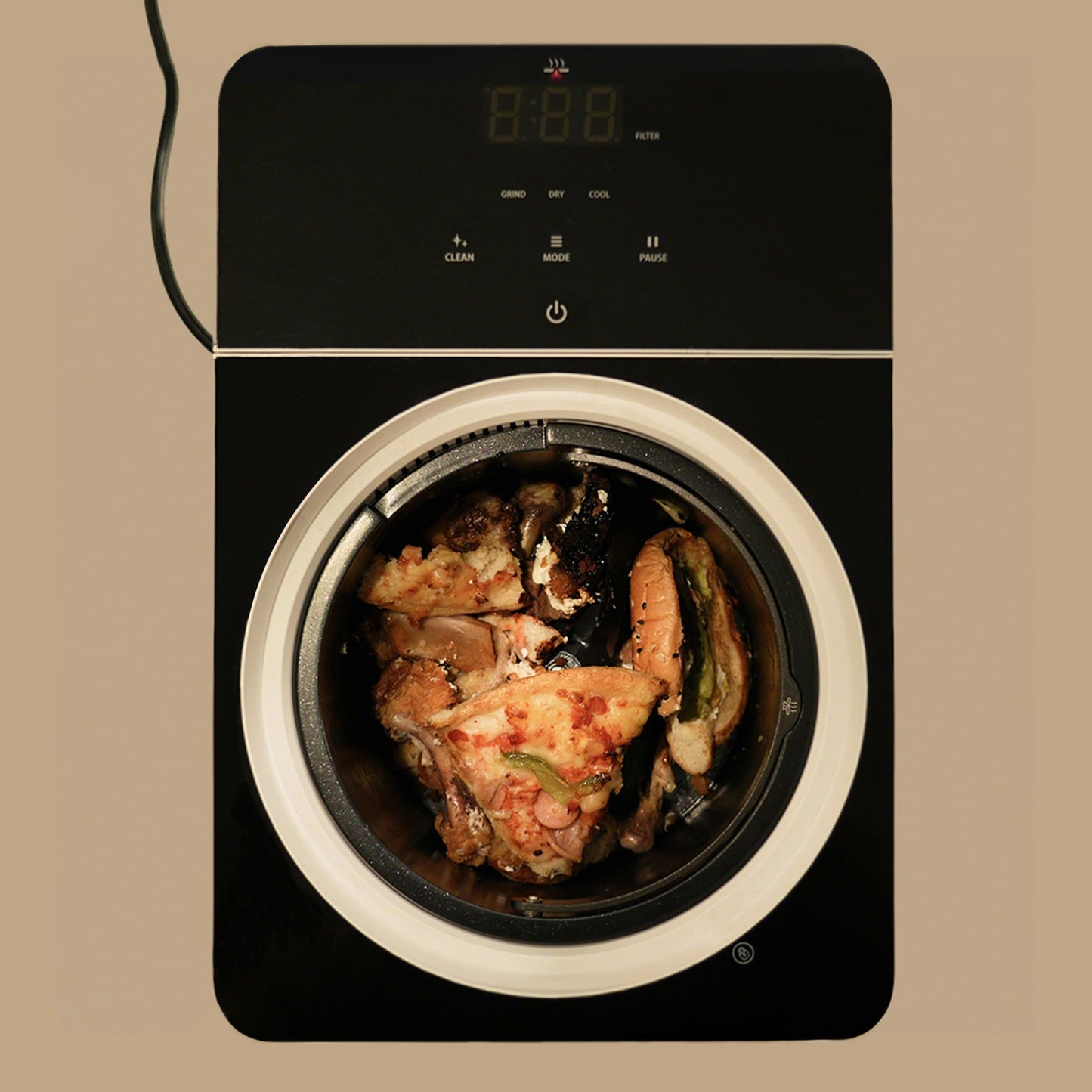
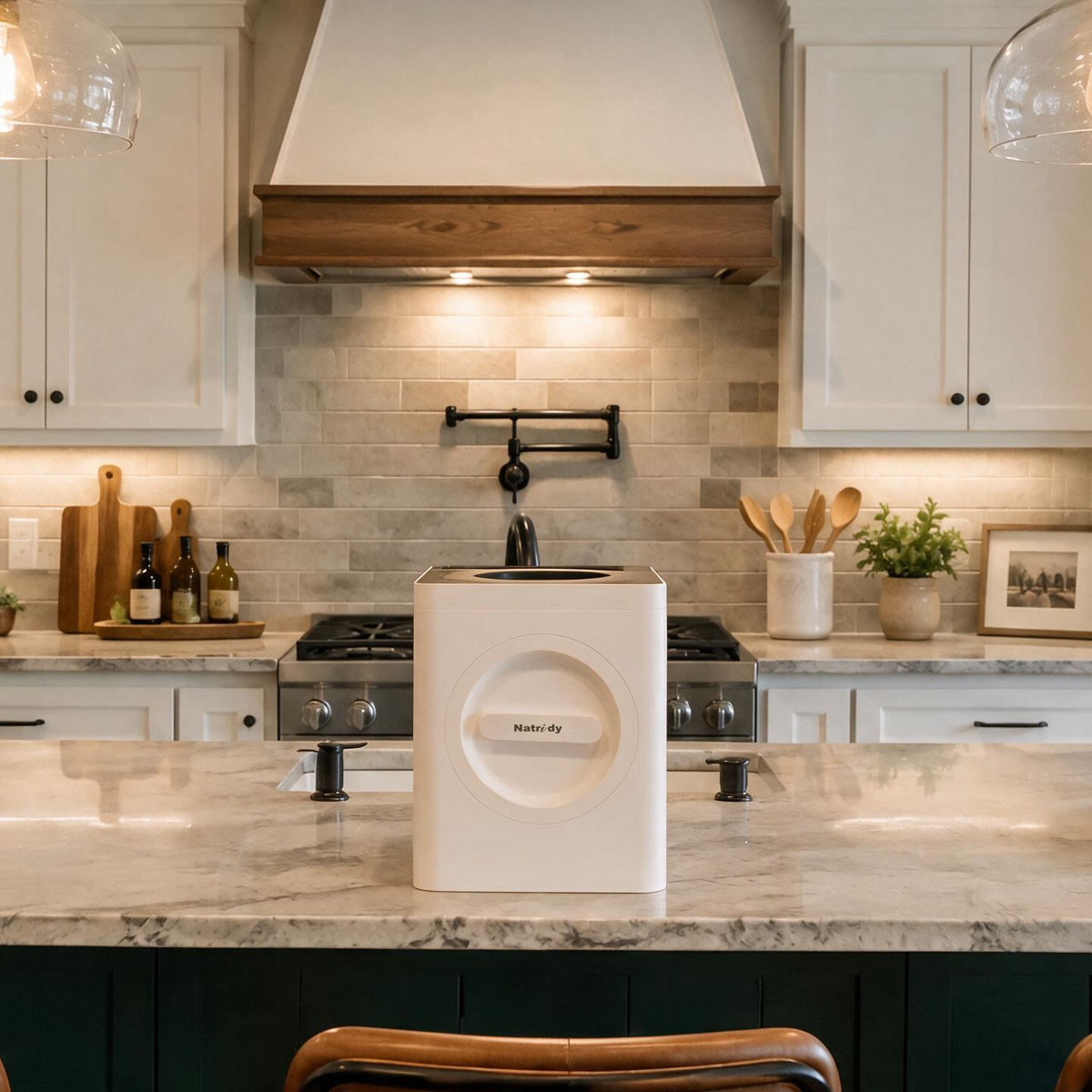
Apartment readers can pair that baseline with the food-scrap smell guide. A batch appliance such as the Natridy Electric Composter changes the storage and processing routine, but no responsible claim should promise that every food mix, room, or handling step becomes odorless.
FAQ
Does a six-month filter interval prove six months of odor control? No. It is maintenance guidance unless it is tied to a disclosed source load, airflow and humidity, carbon medium, inlet/outlet measurement, and breakthrough threshold. Actual use can differ in food mix, moisture, operating hours, cleaning, bypass, and the endpoint an owner notices.
Does more carbon automatically mean better odor performance? No. Installed carbon mass is useful metadata, but performance also depends on the media, geometry, airflow, humidity, source concentration, contact conditions, leaks, and the chosen endpoint. Compare the whole test basis, not one weight printed on a refill page.
Is a human smell check enough? It can be a practical service cue, but it is not interchangeable with an instrument result or an indoor-health assessment. A useful sensory test defines the location, timing, panel, blinding, scale, and failure threshold, and records source and operating conditions.
What should I record when an indoor food-waste system begins to smell? Record the food mix, mass, moisture, storage time, mode, operating hours, room conditions, seal and vent state, cleaning history, filter age, indicator status, and where the odor appears. Follow the exact model guide; do not transfer another brand's restart or service procedure.