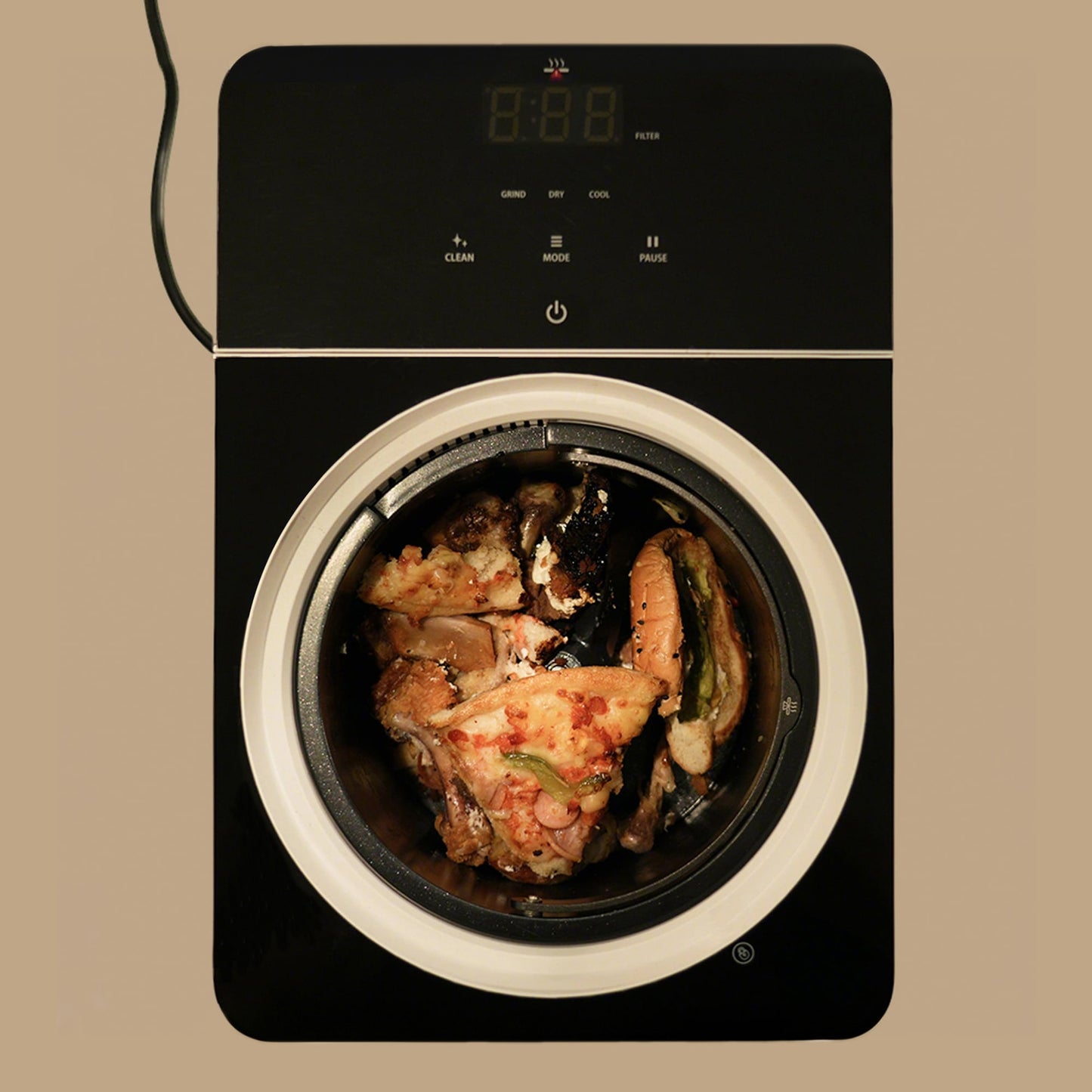
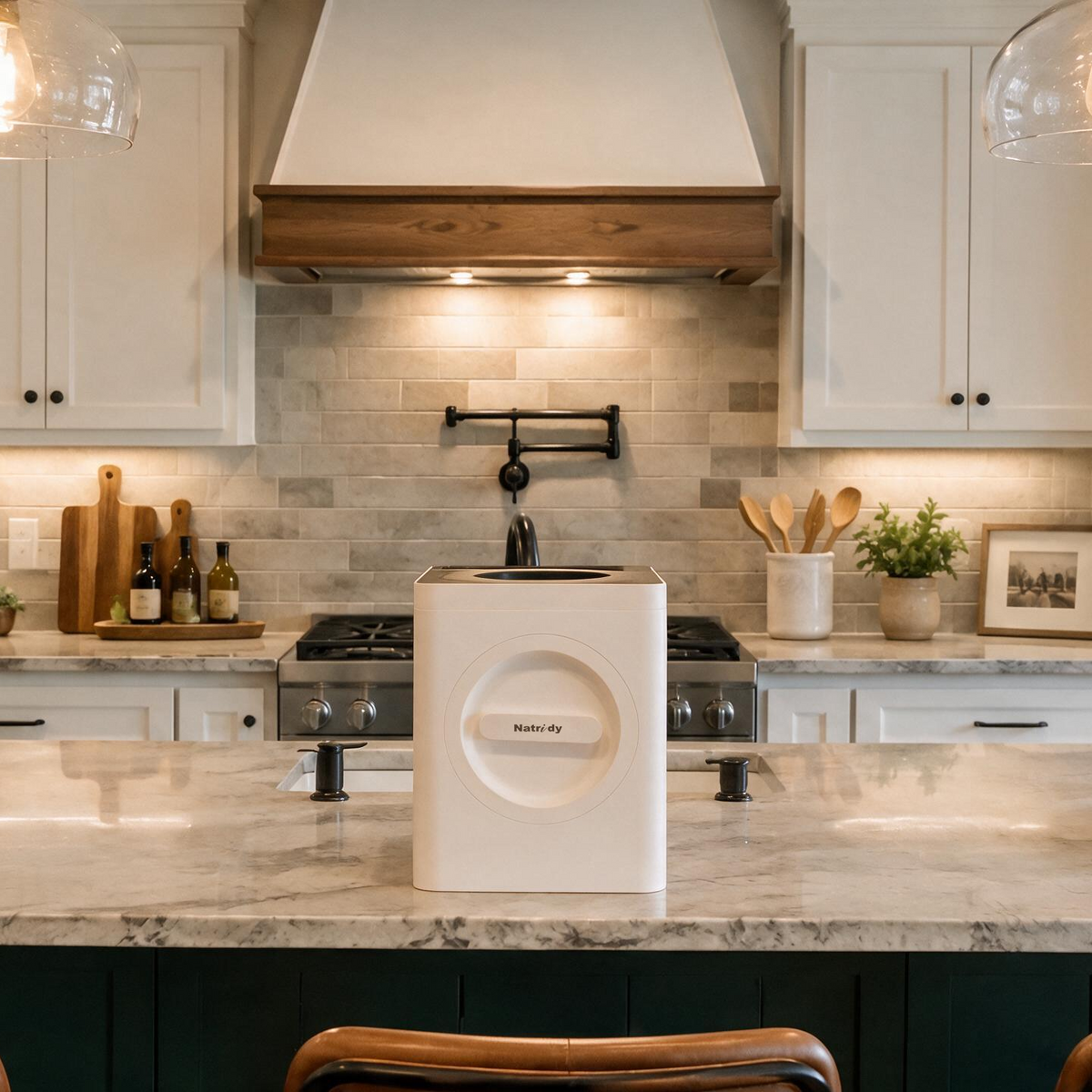
Seven questions before the spec sheet
Before comparing electric composters, decide the household job, counter space, loading rhythm, who empties it, noise tolerance, filter upkeep and the destination of the dry output. These seven questions shape daily use more than any spec sheet. Answer them first to find a unit that fits your family's kitchen routine.
Start with your kitchen routine
Spec sheets compare numbers; households live with routines. A composter that fits your daily flow will get used. One that fights it will sit idle. Think about how your family cooks, cleans, and moves through the kitchen before looking at capacity or cycle time.
Decide the household job, counter space, loading rhythm, who empties it, noise tolerance, filter upkeep and the destination of the dry output before reading any spec sheet.
First, decide the household job. Is this for daily food scraps from a family of four, or occasional peelings from weekend meals? The answer sets the size you need. A larger bin means fewer trips to empty it, but it takes more counter space.
Counter space is the next filter. Measure the spot where the unit will live. Natridy's listed dimensions are 9.84 x 14.3 x 11.8 in. Compare those dimensions with your available space, and account for lid opening and any installation clearances specified in the product instructions. Leave room for loading and for the lid to open fully.
Loading rhythm is about how often you add scraps. Some families scrape plates after every meal. Others collect scraps in a container and add them once a day. Choose a unit that matches your pattern. If you cook often, a unit that can handle frequent small additions may be easier.
Who empties it is a key question. If one person manages the composter, that person's tolerance for mess and lifting matters. If kids help, the bin should be easy to remove and carry. The dry, ground food-scrap material is light, but the bin still needs to be handled.
Noise tolerance varies by home. Natridy's CYF01-500CD5 has a measured noise figure of 39 dB. That figure does not establish whether it will disturb your household or how another product compares under different test conditions. Consider where and when the unit would run.
Filter upkeep is an ongoing task. Most electric composters use a carbon filter to control odors. Check how often the filter needs replacing and what it costs.
Finally, decide the destination of the dry output. Will you use it in the garden, add it to a compost pile, or throw it away? The answer affects how you store and use the material. Some families keep a bucket under the sink; Natridy's output is not finished compost. Mix it into soil or a compost pile to finish, or put it in the trash.
For more on what you can put in the unit, see What Can Go in an Electric Composter?. If you are comparing a batch dryer-grinder with a continuous dry-grounds bin, read Natridy vs Mill: Batch or Retained Bin?.
For the retention distinction, Mill's own emptying instructions describe retaining processed grounds until the fill line. Source accessed 2026-09-17.
Compare the seven factors side by side
Use this table to think through each factor for your household. Write down your answers before you shop. Then you can match them to the specs of any unit.
| Factor | Key question | What to look for |
|---|---|---|
| Household job | How much scrap do you make daily? | Capacity in oz or L |
| Counter space | Where will it sit? | Footprint and height |
| Loading rhythm | When do you add scraps? | Batch loading versus continuous additions, according to the model's instructions |
| Who empties it | Who will remove the bin? | Bin weight and handle design |
| Noise tolerance | When will it run? | Decibel rating |
| Filter upkeep | How often can you replace filters? | Filter life and cost |
| Output destination | What will you do with the dry material? | Texture and moisture level |
The CYF01-500CD5 has a capacity of 100 oz (3 L) and has a 68 oz / 2 L working batch. It uses about 1 kWh per 4-hour cycle. These numbers matter only after you answer the seven questions.
To understand what the unit produces, read What an Electric Composter Produces. If you are ready to see the unit, visit the Natridy Core Unit.
Natridy product specifications
- Model: CYF01-500CD5
- Bucket capacity: 100 oz (3 L)
- Working batch volume: 68 oz / 2 L
- Energy: ~1 kWh per 4-hour cycle
- Noise: 39 dB (measured)
- Output: dry, ground food-scrap material
FAQ
How much counter space does an electric composter need? Measure the spot where you plan to put it. Leave room for the lid to open and for you to add scraps. Natridy's listed dimensions are 9.84 x 14.3 x 11.8 in; your kitchen layout decides whether that fits. A unit that fits your space will be easier to use every day.
How loud is an electric composter? Noise levels vary by model and test conditions. Natridy's CYF01-500CD5 has a measured noise figure of 39 dB. That does not establish whether it will disturb a particular household. Consider the proposed location and operating time, and avoid treating figures from different tests as a controlled comparison.
How often do I need to replace the filter? Filter life depends on the model and on how you use it. For Natridy, the product page says one carbon bag lasts 3 months or 45 cycles, whichever comes first. Check the manufacturer's guidance and refill cost for any unit you compare.
What can I do with the dry output from an electric composter? The dry, ground food-scrap material can be used in several ways. Natridy's dry, ground food scraps are not finished compost. Mix them into soil or a compost pile to finish, or put them in the trash. The best choice depends on your household. Decide this before you buy so you have a plan for the output.